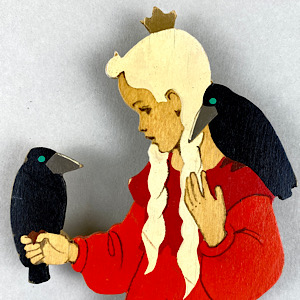
1960er Märchenholzbild German Wall Figure Original Bergischer Engel Gänsemagd 23 cm

1960er Original Bergischer Engel: Anmutige Gänsemagd mit Bandmieder 23 cm Märchen-Holzbild [EN] Goose Girl with Blue Bodice, German Wall Figure

ORIGINAL BERGISCHER ENGEL, EXPERIMENT: Johanna Gruner-Witkop, die ehemalige Besitzerin des Original Bergischer Engel, erzählte mir im neuen Jahrtausend, dass ihre Manufaktur um 1960 herum zwei Schritte der Neuerung bei ihren Holzbildern gewagt hatte. Das eine war der Siebdruck. Dafür besuchte sie einen einwöchigen Kurs, und die Umsetzung gelang ihr bald hervorragend. Der nächste Schritt war, die zusätzliche Bemalung der Ränder der Figuren wegzulassen, die immer noch mit Hand aufgetragen werden mußte. Frau Gruner-Witkop erzählte mir, dass sie zuerst ein schlechtes Gefühl dabei hatte: Würden die Kunden es bemängeln? Würde der Absatz leiden? Erstaunlicherweise passierte keines von beiden – die meisten Leute bemerkten es nicht einmal.

🇬🇧 ORIGINAL BERGISCHER ENGEL, EXPERIMENT: Johanna Gruner-Witkop, the founder and artist of the former manufactory “Original Bergischer Engel” (1940s to 1960s) told me in the new millennium, that there had been two major changes around 1960. One was screen-printing. She attended a special one-week-training to learn the technique and it worked out great. The second step was skipping the additional hand-painting of the sides of the wood plaques. Mrs Gruner-Witkop told me that she had a rather bad feeling about that. Would the customers criticize it? Would the selling numbers suffer? Astonishingly neither happened – most people didn’t even notice it! (9/5)

1960er Märchenholzbild German Wall Figure Original Bergischer Engel Hans im Glück 15 cm

1960er Original Bergischer Engel: Hans im Glück auf großem Schwein, Siebdruck, 20×15 cm, Märchen-Holzbild 🇬🇧 1960s Original Bergischer Engel: Hans in Luck on Large Pig, Screen-printed, 20×15 cm, German Wall Figure

1970er Mertens-Kunst als Original Bergischer Engel: Hans im Glück mit großem Kopf 22×14 cm

1970s Original Bergischer Engel: Hans in Luck with large head | German Wall Figure Märchen-Holzbild

1960er Märchenholzbild German Wall Figure Grossmann Reit im Winkl Zwerg 20 cm

1960er Grossmann Reit im Winkl: Schöner Notenblatt-Zwerg mit vielen blauen Spatzen, Siebdruck, 20 cm, Märchen-Holzbild 🇬🇧 1960s Grossmann Reit im Winkl: Beautiful Sheet Music Gnome with Many Blue Sparrows, Screen-printed, 20 cm, German Wall Figure

GROSSMANN, ÜBERSICHT: Grossmann Reit im Winkl entstand 1948 aus der Not heraus – zunächst in Gudensberg bei Kassel. Das Zeichentalent der Mutter Martha Grossmann erwies sich nach dem Ende des Zweiten Weltkriegs als Segen für das aufblühende Familienunternehmen. 1956 erfolgte der Umzug nach Reit im Winkl in Oberbayern. Selbst in den 1990er Jahren waren dort noch 26 Mitarbeiterinnen und Mitarbeiter beschäftigt: Es wurden weltweit Märchen-Holzbilder, Kindergarderoben und Hampelmänner verkauft und verschickt. Aussprache: Grossmann spricht man mit einem kurzen „O“ aus, wie das „o“ in Frosch.

🇬🇧 GROSSMANN, OVERVIEW: Grossmann Reit im Winkl was officially founded in 1948 in Gudensberg near Kassel. After the Second World War, the artistic talent of the family’s mother, Martha Grossmann, proved to be a blessing for the emerging family business. Her charming designs soon appeared on many German Wall Figures, children’s coat racks and pull-string jumping jacks. In 1956, the company relocated to Reit im Winkl in Upper Bavaria. Even in the 1990s, a staff of 26 people was still employed there: Grossmann products were in demand and even shipped internationally. Pronunciation: Grossmann is pronounced with a short “o”–like the “o” in “frog.” (Buch/25)

1950er Märchenholzbild German Wall Figure Grossmann Reit im Winkl Zwerg 20 cm

1950er Grossmann Reit im Winkl: Roter Zwerg im Spatzen-Gespräch, Handbemalt, 20 cm, Märchen-Holzbild 🇬🇧 1950s Grossmann Reit im Winkl: Red Gnome in Sparrow Conversation, Hand-painted, 20 cm, German Wall Figure

HAPTIK: Das hervorstechendste Merkmal der vergangenen Ära der Märchen-Holzbilder ist die Tatsache, dass die Figuren zwar dünn (meist 3 mm), aber dennoch kompakt und solide waren. Auf Holz gemalt oder auf Holz gedruckt, aber in jedem Fall so, dass man etwas Festes in den Händen hielt. Das ist der große Unterschied zu einer Kinderbuch-Illustration, die nur aus Papier besteht. Es ist auch etwas ganz anderes als die modernen Merchandise-Produkte für Kinder, die in der Regel aus Kunststoff bestehen.

🇬🇧 HAPTICS: The most striking feature of the old German Wall Figures era is the fact that they were made of wood. Very thin (mostly 3 mm), but still something solid. That is a big difference to illustrations in children’s books that only consist of paper. The wall figures were wooden products, and that’s one of the reasons they still create such a special nostalgic feeling: This old-fashioned Brothers Grimm “merchandise” didn’t come in plastic. That’s why they appeal to collectors in the new century, too. (Buch/25)

1940er Märchenholzbild German Wall Figure Original Bergischer Engel Hans im Glück 21 cm

1940er Original Bergischer Engel: Beschädigter früher Hans im Glück mit Augenweiß, Handbemalt, 21 cm, Märchen-Holzbild 🇬🇧 1940s Original Bergischer Engel: Damaged Hans in Luck with Eye White, Hand-painted, 21 cm, German Wall Figure

ORIGINAL BERGISCHER ENGEL, DM-MESSE 1948: Johanna Gruner-Witkop erzählte mir im hohen Alter von 90 Jahren auch von ihrer ersten großen Messe. Sie fand vom 3. bis 8. Oktober 1948 in Frankfurt statt, nur drei Monate nach der Einführung der D-Mark – daher der Name „DM-Messe“. Es war keine reine Spielwarenmesse, sondern eine allgemeine Handels- und Produktmesse. Frau Gruner-Witkop erinnerte sich, dass die Räume teilweise nur provisorisch eingerichtet waren, es gab sogar zusätzliche Zelte, und den Geschäftsleuten wie auch den Kunden steckten die sechs Kriegsjahre des Zweiten Weltkriegs noch in den Knochen. Menschen leben immer in eine ungewisse Zukunft hinein, und niemand wusste damals, was wir heute wissen: dass es Gott sei Dank der letzte deutsche Krieg des 20. Jahrhunderts gewesen sein sollte – und dass bald das Wirtschaftswunder kommen würde.

🇬🇧 ORIGINAL BERGISCHER ENGEL, DM-FAIR 1948: At the age of ninety, Johanna Gruner-Witkop also told me about her first major fair. It took place from October 3 to 8, 1948, in Frankfurt, only three months after the introduction of the Deutsche Mark – hence the name “DM Fair.” It was not a pure toy fair but a general trade and product fair. Mrs. Gruner-Witkop recalled that many of the halls were only provisionally set up, with additional tents, and that both businesspeople and customers still carried the burden of the six years of the Second World War. Life is always lived facing an uncertain future, and no one knew what we know today: that, thankfully, it would be the last German war of the 20th century – and that the Economic Miracle was soon to come. (9/5)

1970er Mobilefiguren? German Wall Figure Grossmann Reit im Winkl Zwerge 6–12 cm

1970er Grossmann Reit im Winkl: Sammlung von Mini-Zwergen von Mobile, Siebdruck, 6–12 cm, Märchen-Holzbild 🇬🇧 1970s Grossmann Reit im Winkl: Collection of Mini Dwarfs from Mobile, Screen-printed, 6–12 cm, German Wall Figure

GROSSMANN, ÜBERSICHT: Grossmann Reit im Winkl entstand 1948 aus der Not heraus – zunächst in Gudensberg bei Kassel. Das Zeichentalent der Mutter Martha Grossmann erwies sich nach dem Ende des Zweiten Weltkriegs als Segen für das aufblühende Familienunternehmen. 1956 erfolgte der Umzug nach Reit im Winkl in Oberbayern. Selbst in den 1990er Jahren waren dort noch 26 Mitarbeiterinnen und Mitarbeiter beschäftigt: Es wurden weltweit Märchen-Holzbilder, Kindergarderoben und Hampelmänner verkauft und verschickt. Aussprache: Grossmann spricht man mit einem kurzen „O“ aus, wie das „o“ in Frosch.

🇬🇧 GROSSMANN, OVERVIEW: Grossmann Reit im Winkl was officially founded in 1948 in Gudensberg near Kassel. After the Second World War, the artistic talent of the family’s mother, Martha Grossmann, proved to be a blessing for the emerging family business. Her charming designs soon appeared on many German Wall Figures, children’s coat racks and pull-string jumping jacks. In 1956, the company relocated to Reit im Winkl in Upper Bavaria. Even in the 1990s, a staff of 26 people was still employed there: Grossmann products were in demand and even shipped internationally. Pronunciation: Grossmann is pronounced with a short “o”–like the “o” in “frog.” (Buch/25)

1950er Hampelmann German Wall Figure Original Bergischer Engel Kasper 24 cm

1950er Original Bergischer Engel: Großartiger Kasper-Hampelmann mit Klatsche und Krokodil, Handbemalt, 24 cm 🇬🇧 1950s Original Bergischer Engel: Magnificent Kasper Jumping Jack with Slapstick and Crocodile, Hand-painted, 24 cm

ORIGINAL BERGISCHER ENGEL, HAMPELMÄNNER: Die Gründerin und somit die erste Besitzerin des Original Bergischer Engel, Johanna Gruner-Witkop, hat damals viele Kinder-Wandfiguren hergestellt – sie war aber auch für ihre sehr originellen Hampelmänner bekannt. Es gab zum Beispiel ein Mädchen mit Hampelzöpfen, einen Kasper mit Krokodil und Klatsche, eine Fischfrau mit einer Metallglocke, die schöne Schornsteinfegerin mit vierblättrigem Kleeblatt, das Pilzmännlein mit Fliegenpilz-Hut und einen Jägerjungen mit Dackel. Für die Herstellung wurden zwei unterschiedliche Holzarten verwendet, die intern „Märchen-Holz“ und „Hampelmann-Holz“ genannt wurden. Die inzwischen verstorbene Johanna Gruner-Witkop hatte mir im Februar 2019 noch davon erzählt: Das Holz für die Märchen-Holzbilder war immer weicheres Holz gewesen; das Holz für die Hampelmänner hingegen härteres Holz. Einer meiner Favoriten der Original-Bergischer-Engel-Hampelmänner ist die blonde Bäckerin mit den Brezeln und der Karohose.

🇬🇧 ORIGINAL BERGISCHER ENGEL, JUMPING JACKS: The founder, artist, and first owner of the Original Bergischer Engel, Johanna Gruner-Witkop, made many children’s wood plaques; but she was also famous for her very original jumping jacks. For example, there was a girl with jumping pigtails, a Kasperle (Mister Punch) with a crocodile and a swatter, a fish woman with a metal bell, a little guy with a toadstool hat, and a hunter boy with a dachshund. Two different types of wood were used for the production, which were internally called “fairy tale wood” and “jumping jack wood”. The now deceased Johanna Gruner-Witkop told me about that in February 2019: The wood for the fairy tale plaques was always softer wood; the wood for the jumping jacks, however, was denser wood. One of my favorites of the Original Bergischer Engel jumping jack toys is the blonde baker girl with the pretzels and the checkered pants. (Buch/25)

1960er Mertens-Kunst als Original Bergischer Engel: Bunter Zwerg mit Handvogel 22 cm

1960s Mertens-Kunst as Original Bergischer Engel Handvogel: Dwarf with Bird in Hand | Märchen-Holzbild

1940er Märchenholzbild German Wall Figure Grossmann Reit im Winkl Zwerg 17 cm

1940er Grossmann Reit im Winkl: Roter Zwerg mit hohem Hut und weißem Sockel, Handbemalt, 17 cm, Märchen-Holzbild [EN] Red Dwarf with Tall Hat and White Base, German Wall Figure

GROSSMANN, E-MAILS: Ich bin sehr dankbar für die freundlichen E-Mail-Antworten von der Grossmann-Tochter Hannelore Grossmann vom Oktober 2016. „Hallo Frau Dietz, unsere Firma gibt es seit dem 01.08.1948. Ich finde es super, daß Sie die alten Holzbilder gesammelt haben. Viele Grüße aus Reit im Winkl, Hannelore Grossmann.“ Weitere E-Mails enthielten wertvolle Informationen: „Grossmann spricht man wie das kurze o in Frosch. Meine Eltern haben 1948 den Betrieb aus der Not heraus gegründet in Gudensberg bei Kassel. Dank der Malkunst und Fantasie meiner Mutter wurden u.a. die Holzbilder entwickelt und ca. 10 Jahre mit der Hand bemalt und danach im Siebdruck gefertigt. 1956 übersiedelten meine Eltern nach Reit im Winkl. In den 90er Jahren hatten wir 26 Mitarbeiter und haben weltweit geliefert. Heute produzieren wir nur noch Geburtstagszahlen und -Herzen in ganz kleinem Rahmen. Der Name meiner Mutter ist Martha Grossmann. Möglich, daß sie das Rotkäppchen (Anmerkung: Ich hatte ihr ein Foto gesendet) selbst bemalt hat, aber auf jeden Fall vorgezeichnet.“

🇬🇧 GROSSMANN, EMAILS: I am very grateful for the kind email responses from Grossmann’s daughter Hannelore Grossmann, sent to me in October 2016. “Hello Ms. Dietz, our company has existed since August 1, 1948. I think it’s great that you collect the old wood pictures. Best wishes from Reit im Winkl, Hannelore Grossmann” (translated). The following emails contained further valuable information: “Grossmann is pronounced like the short o in ‘frog.’ My parents founded the company out of necessity in 1948 in Gudensberg near Kassel. Thanks to my mother’s painting skills and imagination, the wood figures, among other things, were created and painted by hand for about ten years, and later produced with screen printing. In 1956, my parents moved to Reit im Winkl. In the 1990s we had 26 employees and shipped worldwide. Today we only produce birthday numbers and hearts on a very small scale. My mother’s name was Martha Grossmann. It’s possible that she painted the Little Red Riding Hood (note: I had added a picture in my email), but she definitely drew the outlines.” (Buch/25)