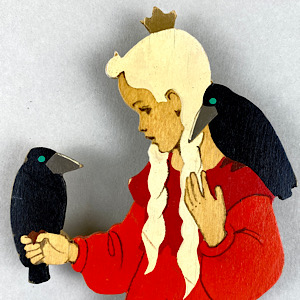
🇬🇧 German Wall Figures from A–Z
ABOUT THE ERA: The era of German Wall Figures lasted from the 1920s to the 1980s. In Germany, millions of these children’s wood pictures were produced, but also in other countries–especially the Netherlands (many with a “Holland” stamp). Large German manufacturers were Hellerkunst, Mertens-Kunst, Ravi-Kunst, Grossmann Reit im Winkl, Original Bergischer Engel, Münchner-Kunst, and many more. In total–including the many small, now-forgotten manufacturers–there were probably several hundred in Germany. And of course, there were also countless hobby craft items made at home, most often based on templates, which were widely available throughout the last century.
ALSA: I once acquired a large collection of wall figures from the Netherlands, including 27 pieces by Alsa and Kleur & Profiel. Alsa figures often feature exceptionally thick plywood (almost 1 cm) and have vibrant, vivid colors. The Alsa logo is round, containing four stylized letters spelling „Alsa.“ I’ve seen this logo both as a shiny golden sticker and as a stamp. Most Alsa wall figures, however, lack either marking, yet their style remains distinctive: the large Little Red Riding Hood (32 cm), holding a huge bee amid a bouquet of flowers, has the same delicately drawn blue eyes as the similarly sized Little Hiker (33 cm), who fortunately has the stamp! First and foremost, researching mid-century wall figures involves close observation and careful comparison. Other common Alsa motifs include houses, toadstools, toadstool houses, geese, trees, a cloud, and the large wolf matching the Little Red Riding Hood. I’d love to learn more about Alsa—can anyone help?
ANDERSEN: The major difference between the Brothers Grimm and Hans Christian Andersen is that the Andersen fairy tales are so-called “artistic fairy tales,“ invented by Hans Christian Andersen from Denmark (1805–1875), while the Brothers Grimm fairy tales are very old fairy tales; according to more recent theories, some are not just hundreds, but thousands of years old. Most Wall Figures based on Andersen fairy tales came from Asti in Denmark. Examples include: The Little Match Girl, The Little Mermaid, The Emperor’s New Clothes, The Tinderbox, The Shepherdess and the Chimney Sweep, and The Wild Swans. Andersen motifs from other manufacturers include: The Princess and the Pea (Mertens and Ravi), The Princess and the Swineherd (Heller, Hilla, Erika Bartels), Thumbelina (Mertens, Ravi, Eifelkunst), and The Little Match Girl (Ravi, Hilla).
ANGELS AND RELIGIOUS MOTIFS: Religious themes are rarely found on historic German Wall Figures. But there are two exceptions: One is the subject of Christmas, especially the nativity scene with Mary, Joseph, and the baby Jesus in the manger. The second exception are angels, which many people do not necessarily associate with religion: Even non-religious people often cherish angels as beloved symbols of protection.
ARGUMA: Arguma was one of many small manufacturers of German Wall Figures in the last century. One known example is a small red dwarf running across a colorfully dotted meadow, most likely from the 1930s or 1940s. The stamp on the back is quite elaborate: the word „Arguma“ appears in a semicircle above a large circle containing the letters „MHB,“ with the word „Handarbeit“ („handcrafted“) underneath. I like to imagine that „MHB“ stands for Märchen-Holzbilder—the German genre name I gave to the wall-figure era—but it is probably just a set of initials. Given the elaborate stamp, it is likely that Arguma produced many more German Wall Figures over the course of the last century–more than just the one I know so far.
ARNHEM COLLECTION: There is a small collection of wall figures from the last century, which I call the „Arnhem Collection.“ It consists of children’s wood figures that a soldier sent to his family in Germany during the Second World War. Some of the backs are inscribed with „Arnheim 1942″—for example, a girl in a light blue dress with a knee-length braid. She is plucking petals from a white flower; it appears to be the counting game „He loves me, he loves me not.“ The Arnhem flower girl bears the date April 10, 1942. Another figure shows an enchanting yellow Snow White in a coat dress, surrounded by dancing dwarfs. The soldier father had written on the back in fountain pen as follows: „Thus we poor dwarfs dance around you women. Arnhem, January 10, 1942” (translated). Both figures were presumably made by Dutch manufacturers. Other fairy tale wood pictures from the Arnhem Collection were motifs by Mertens and Heller.
ASTI-KUNST: The “specialty” of the Danish manufacturer Asti-Kunst Kunst were the fairy tales of Hans Christian Andersen (1805–1875), which are so-called „literary fairy tales,“ as they were written by him and had not been passed down through tradition. Examples of Asti wall figures with Andersen motifs include Ole Luk-Oie / Ole Lukoie (Ole the Eye-Closer), the Danish Sandman with umbrella and syringe, and The Little Match Girl. I think that Asti produced their wood plaques from the 1930s to the 1950s, initially with full hand-painting, and later using a type of screen-printing process with hand-painted edges. The round back stamp also changed over time: first it was embossed, later stamped on. The label remained the same: the name „Asti-Kunst“ with a charming little candle-holding girl. Does anyone know more about Asti-Kunst from Denmark? Please get in touch!
AXE DWARF COLLECTION: I know a collection of five fretsaw figures that a great-granddaughter received from her great-grandfather–all unusual wall figures: a Sandman, Snow White, Little Red Riding Hood with the Wolf, and a Christmas-tree-chopping axe dwarf. She said that her great-grandfather had wanted to become a graphic artist but wasn’t allowed to do so at the time. He lived in Saxony. So if he grew up „locked up“ in the GDR (people weren’t allowed to leave the country back then), this was not unusual, as the communist state denied many people their desired careers, even if there was a lot of talent. So he crafted handmade items for his family–first for his daughter, then for his granddaughter and great-granddaughter. It is a wonderful gift when people truly know their talents and have a clear career goal–and all the more tragic when they are unable to pursue it.
BREECHES-MAKER: The most famous “breeches-maker” of all times was Daniele da Volterra who had to overpaint the too naked people in the Sistine Chapel after Michelangelo had refused to do so. Many of the larger wall figures manufacturers of the last century also became breeches-makers, at least with their dwarf figures. Most of the early Art Deco gnomes had had naked legs, but in the 50s/60s they suddenly got trousers. For different reasons, obviously, and I think it was because of this: The figures became more stable, because the earlier narrow legs were rather fragile. Also, trousers are easier to draw than knobbly knees. And the look of the figures was supposed to get a more modern touch.
BROTHERS GRIMM TO HOLD: It was primarily the Brothers Grimm heroes who were immortalized on the German Wall Figures back then. Such a gift gave a child something solid to hold–a wooden embodiment of their bedtime stories. Now, in the new millennium, many adults are collecting these figures again. This is certainly also due to the fact that in today’s digital age, something tangible, something stable, something made from the primal material of wood is newly appreciated–especially when it brings back childhood memories. Strangely enough, this is also true for those who, as children, never knew or owned any of these wood pictures from high-quality manufacturers such as Heller, Mertens or Ravi. I am one of them: I held such a figure in my hands for the first time in 2014, although I was born back in 1963.
BRUENHILD SCHLÖTTER: It’s possible that the famous children’s book illustrator Brünhild Schlötter created some designs for Alfred Mertens in the 1930s. The resemblance between some of Mertens’s German Wall Figures and the ethereal characters in Brünhild Schlötter’s fairy tale books is striking–the delicate lines, the long, waterfall-like hair. Does anyone know more about this? So far, all I know about Brünhild Schlötter is that she was probably born in Munich in 1911 and studied painting during the 1930s.
BURKERT: Many of the German Wall Figures by this manufacturer were produced during the Communist GDR era (1949–1990), with the price listed in the now-discontinued currency “GDR Mark” on the reverse side. Production took place in the town of Olbernhau, which belongs to the so-called “Land of Toys” in the heart of the Ore Mountains. What makes Burkert wall figures special is their 3D effect: they are made of significantly thicker wood than most others, and the surface includes carved details.
CANDLE HOLDERS: Many producers of German Wall Figures also made plywood candle holders in the last century. Some were mounted to the wall, and some could stand on a table. The manufacture Heller, for example, made both. An especially cute standing figure by Heller is a small angel with a red cloth: He is polishing a golden star. Mertens made small candle holders too—most of them were dwarfs. I’ve also known a wooden birthday ring by Mertens with several tiny candles, on which hand-painted small naked-knees gnomes stood. The manufacturers from the GDR, especially in the Ore Mountains, produced hundreds of different tiny candle holders made of plywood back then, showing Christmas angels and winter children with snow.
CANDLE LIGHT: I love wall figures with candles on them. Especially pretty are those candles with an aura, where you can see the light of the candle or a candle-like shine. There are several ways of drawing this: Magda Heller sometimes used a mysterious green light—a fairy light, for example on the magic lamp/lantern of the Aladdin wood plaque.
CARDBOARD FIGURES: Some manufacturers of German Wall Figures switched from wood to cardboard during the Second World War, mainly because there was a shortage of plywood and other materials. I found a stamp on the back of some cardboard figures that translates to: “Painted on cardboard for a while”. I’ve seen this for example on a hand-painted Cinderella figure with yet another stamp on the back with the producer’s name: Unfortunately it’s hard to decipher, it seems to be the word “Kunsttruhe” (Art Chest) and there is even a picture of a chest in the stamp. There are also some producers that made cardboard figures outside the Second World War. They are all an exception though in the German Wall Figures era, which lasted from the 1920s to the 1980s and had one thing in common: They were wood plaques.
CHILDREN, WITH TOYS: The old German Wall Figures were sometimes shown with typical toys from back then. Apart from the popular dolls, there were, for example, the following motifs by Mertens: 1950s Boy with Locomotive, 1970s Jeans Boy with Toy Train, 1970s Boy with Indian Tent (native American), 1930s Rocking Horse Boy with Sailor Collar, 1970s Rocking Horse Boy with Striped Shirt, and 1970s Beach Ball Girl with sand toys. Other toys on wood plaques included, for example, hobby horses, teddy bears, kites, and cowboy outfits.
CHRIJO MÜLLER: This old manufacturer’s colorful and humorous style is somewhat reminiscent of comic strip drawings–for example, the Mother Holle with the Golden Mary, who are gazing at each other. The stamp on the back reads: “Kunstgewerbl. Werkstätten Chrijo Müller Hann. Münden” (Lower Saxony). I believe that Chrijo Müller produced his work in the 1930s, but there may also be a connection to Ruth Müller, who created the miniature wooden cityscapes “Münden in a Box”. However, Ruth Müller didn’t arrive in Hann. Münden until 1945 (as a refugee from the East). So far, I know only one dated copy of the Chrijo Müller night watchman, bearing the dedication “Christmas 1945.” All Chrijo Müller motifs are unique, original, and made from particularly thick plywood. Other examples include Snow White standing on seven hearts, and a dwarf waving his stocking cap. Does anyone know more about Chrijo Müller? Please get in touch!
CLARA STEIGER: There are beautiful German Wall Figures from the 1930s bearing the “Clara Steiger” stamp on the back—unfortunately, it’s hard to decipher. Their children’s wood plaques are very delicately and softly drawn and hand-painted, featuring motifs I have only ever seen from this artist. For example, there is the white “Kajol Snow White,” which I call that because—with her long black braid and friendly, open gaze—she resembles the famous Indian actress in her early years. Another Clara Steiger figure shows two children (almost) kissing: the light-blue boy in a short doublet-like jacket with a peplum, the girl in a red sleeveless dress with a wide, flared skirt—both have blue and red shoes, too. Unfortunately, the rest of the stamp is also barely legible; overall, it might read: “Clara Steiger, Radebeul, Hindenburgstraße.” It could be a manufacturer’s stamp or possibly an owner’s mark. I would love to learn more about these beautiful wall figures by Clara Steiger!
CLEANING: Cleaning the old German Wall Figures is actually a problem! I once had the chance to ask an expert about this, Birgit Linnhoff, a graduate conservator/restorer in Kiel. She strongly advised against cleaning the old wood pictures at all, only removing dust with a soft paintbrush if necessary. The top layer (lacquer) preserves the lines and colors, and it should not be destroyed by rubbing or using liquids, not even water or mild cleaning agents. I have experimented a lot with cleaning wood pictures, and I once ended up with a beautiful antique Heller figure that had dull colors instead of the bright ones after cleaning it. So, if you do want to clean a wood plaque, be careful: It may be best to try it first on a small part of the figure to see how the colors react.
COAT RACKS, GROWTH CHARTS, DIORAMAS: Most manufacturers of German Wall Figures in the last century also produced larger supplementary items. Children’s coat racks came, for example, from Mertens, Heller, Kleur&Profiel (Netherlands), and Grossmann. Many producers also made children’s growth charts. One of the most beautiful Mertens growth charts shows children from various nations and historical eras—most of them now politically incorrect: for example, Native American boy, Mayan boy, Eskimo (Inuit) girl, Japanese girl in a kimono, Greek girl in ancient attire, Dutch girl, African girl in a raffia skirt, and a Mexican boy. Dioramas without coat rack function were produced until the 1960s; the greatest variety came from Munich manufacturers—such as a Puss in Boots figure with a fairy tale carriage. Mertens also made very small dioramas with mini-figures, like a Snow White with all the seven dwarfs, mounted on a narrow wooden strip.
COLONIAL GOODS STORE COLLECTION: I’ve known a collection of very early, still completely hand-painted Weha wood plaques and some other German Wall Figures that came from a colonial goods store. Someone remembered and kindly wrote to me about it: “The store was located on the main street of Sundhausen near Gotha (German state of Thuringia). They sold everything from coffee to tobacco to fabric—everything needed for everyday life. And wood toys, too.” One thing still puzzles me: I was told the collection comes from the 1930s, but according to the now defunct Weha website, the production of German Wall Figures by Weha didn’t start until 1946. My guess is this: Fritz Haupt, the founder of Weha, had already produced fairy tale wood plaques before 1946, but only after the Second World War did large-scale production begin.
COPYCAT MANUFACTURERS: Especially in the 1940s, many small makers of German Wall Figures had their own stamp on the back (often including only the word “Handarbeit” for handmade), making them technically official manufacturers. However, those “copycat manufactureres” primarily copied motifs from other companies. These “copycats” included Rosma, Karl Klier’s “Frankenkunst,” and also Oltmanns–although Oltmanns managed to give the copied figures (mostly Heller motifs) a distinctive and even high-quality style of their own. Most of these “copycat manufacturers” were born out of wartime necessity and belonged to the group of “kitchen-table manufacturers” without proper workshops. Sometimes, the figures were based on legal hobby templates, such as those by Vobach or Hartmann/Hartmanns. Heller never took legal action against the copying–this was told to me in the new millennium by Klaus Heller, a son of Magda and Georg Heller. Mertens, on the other hand, explicitly forbade imitation.
CRADLE CHILDREN: The cradle was a popular motif in the vintage German nursery. Producers of wall figures made them with or without canopy, with sitting or lying children, sometimes with siblings, too. Some manufacturers made different designs over the decades. A very rare item comes from Ravi: A baby in a powder blue canopy cradle with the older sister next to it who is pointing to the bird on the crest. The figure also has a red base, which is very unusual for Ravi, too.
CURRENCIES: On the backs of the German Wall Figures from the last century, you’ll sometimes find the price that toy stores or art craft stores asked back then. However, the currency is almost never not specified. Unlike countries like the USA, where the dollar has been the currency for ages, Germany had five different currencies during the last century, not even counting the various emergency bills issued around 1920 during the inflation period. Since the German Wall Figures era spanned from the 1920s to the 1980s, the asking price could be in one of the following currencies: 1888 to 1923: Mark, 1923 to 1924: Rentenmark, 1924 to 1948: Reichsmark, 1949 to 2001: Deutsche Mark (West Germany/FRG), 1968 to 1990: DDR-Mark (East Germany/GDR).
CUTENESS: “Cuteness” is actually a scientific expression. The German term for it (“Kindchenschema”) is internationally used: It was coined by the German zoologist Konrad Lorenz (Nobel Prize winner) in the last century. A large head and big eyes make people (and mammals, too) intuitively want to protect the young ones. These cute motifs were especially popular in the 1960s and 1970s. Many producers of German Wall Figures applied this to their children’s wood plaques. Example: The 1930s Mertens Snow White with the longest braid (and a baby belly) has a very small head, while the 1960s Mertens “Ball Dress Snow White” has a head three times its size.
DAMAGED, BUT THERE! Sometimes I come across German Wall Figures from the last century that are damaged, but also rare and interesting. In such cases, some damage is no problem–it’s simply a joy to be able to hold the piece at all. This is especially true for very rare and particularly wonderful motifs. Example: the Bee Fairy by Heller.
DEDICATIONS: There are many wonderful dedications on the backs of the old German Wall Figures. I am especially happy when there is a date mentioned with the year, too. My all-time favorite unfortunately is not dated, but the figure seems to be from the Sixties. It is from a loving grandmother. The dedication is written on the back of a Little Brother and Little Sister figure made by the GDR manufacturer Burkert in Olbernhau in the Ore Mountains. She wrote: “For my Reiner above his crib from your Granny.”
DOG MOTIFS SERIES: I know three different wood plaques so far that show dogs that probably all come from the same manufacturer, most likely from around the middle of the last century. Unfortunately there is no information on the backs of the figures. The motifs are as follows: A lovely little terrier with a shoe in his mouth on a red base, a black and white pair of poodles with a red bow and a biscuit basket on a gray base and a second black and white pair of poodles with red collars on a red base. It could well be that the manufacturer is not from Germany. Does anyone know more about it? Please get in touch!
DOLL MOTHERS: Many producers of the old German Wall Figures had doll mother figures, sometimes with accessories like a doll pram, baby sling, cradle, teddy bears or even a spoon to feed the doll. They came in different hair colors because most human doll mothers liked a wall hanging with her own hair color. The black hair doll mother by Mertens had a pretty white flower crown. My favorite stems from Mertens, too: It’s the dancing doll mother with braids from the Fifties.
DORLE ZAUCHE: A Hans in Luck with red heels is a wood picture by Dorle Zauche. The back stamp reads: “Dorle Zauche, Kunstgewerbliche Werkstätte.” This German Wall Figure depicts the Brothers Grimm’s Hans with a goose, a red polka-dotted scarf, and a green hat. It may be one of the many “kitchen-table manufacturers” that emerged during the Second World War, when many people were in need and urgently looking for sources of income. The rather simple stamp supports this theory. However, this wood picture might also date from the 1930s.
DRAFTS AND BLANK PLAQUES: It’s fascinating to hold an unfinished German Wall Figure in your hands and glimpse something of the production technique. I’ve come across half-finished pieces where only the preliminary drawing is visible—or just the base white coat on the blank. I’ve also seen figures with faint sketches on the back—early drafts that had been abandoned when the front was eventually painted. Why were some beautiful figures never completed? Life may have intervened: between 1939 and 1945, the reason may well have been the Second World War. I know, for instance, that the workshop of Karin von Wrangell (Wrangel-Kunst) was “bombed out” during the war.
DULLIEN: Around the middle of the last century, Dullien produced many different and often highly original fretsaw templates for hobby crafters, in the form of pre-printed wooden boards ready to cut out. Dullien’s specialty was the beautifully colorful sample sheets that came with the templates, usually with a bright yellow background. One example was a cute, happy girl holding a giant ladybug—almost the size of her hand. Another typical Dullien child was the little lemonade cowboy. Dullien’s successor was MK-Hobby (Michael Kramer), who went on to design fretsaw templates for Pebaro (Peter Bausch Ronsdorf).
DWARFS, BASIC OVERVIEW: Dwarfs or gnomes were very popular in the era of German Wall Figures (1920s to 1980s). Many professional wood art manufacturers made those beautiful wood plaques: Heller, Mertens, Ravi, Bergischer Engel, Ilse Schneider of the Eifel region, the Munich producers, Edelholz Freiberg from the Ore Mountains, Kurt Süß (GDR), and many more. Many dwarfs were produced by Grossmann in Upper Bavaria. Loveable little gnomes were Grossmann’s specialty, and they shipped thousands of them to the USA and other countries. But also the producers of hobby craft templates offered many different dwarf motifs, especially Johannes Graupner. He also provided one of the most unique fretsaw figures: The Chef Dwarf with a poisonous mushroom dish and a cat.
DWARFS, WITH ANIMALS: The combination of gnome and animal on German Wall Figures was very popular back then. Alfred Mertens, for example, had several series with this combination: Dwarf with Doe, Dwarf with Fox, Dwarf with Mouse, Dwarf with Butterfly, Dwarf with Squirrel, or Dwarf with Bird. Grossmann, the dwarf expert, also combined many of their gnomes with animals. For example, there is a cute mid-century figure of a fox giving paw. The template producer Johannes Graupner/Graubele had some pretty motifs in store, too: “At the Forest Doctor’s” shows a dwarf fixing a doe’s injured knee, and “The Bird Doctor” has a dwarf spoon-feeding medicine to a bird with a cold.
EBRO: So far, I’ve seen about ten figures by Ebro from The Hague (Netherlands). Three are very large (up to 30 cm), richly detailed, and always depicted in motion: a prancing Aladdin holding a large round magic lamp, an ecstatic Rumpelstiltskin with his right index finger pointing to the sky, and a reading dwarf sitting atop a stack of books. My favorite of the smaller plaques is a dwarf playing a golden harp. The elaborate Ebro stamps are always in two parts, usually smeared and hard to decipher. So far I’ve been able to make out “Ebro Holland Den Haag” on the round stamp, which looks like an old-fashioned postal stamp with a crown and wings. The second stamp is rectangular, designed to include a handwritten model number. Does anyone know more about Ebro? Please get in touch!
ECONOMIC MIRACLE FIGURES: The German Wall Figures of the 1950s and 1960s were often particularly cheerful and carefree. The people on these wood pictures had practically learned to smile. The Second World War and the famine years shortly thereafter were over, the German economic miracle had begun, and many children were being born—very many. That’s why we also speak of the baby boom and the baby boomers. I was born in 1963, so I am one of those children. A 2009 book by Martin Rupps bore the appropriate title: „We Baby Boomers … We Were Always Too Many.”
EDELHOLZ FREIBERG, BASIC OVERVIEW: This manufacturer from the Ore Mountains produced German Wall Figures from the 1940s to presumably the 1960s under its own name. The owner–and most likely also the artist–was Margarethe Edel. The name “Edelholz” (literally “precious wood”) likely stems from her surname and fits well with the high quality of the figures. “Edelholz Freiberg” was officially registered in the Freiberg commercial register in 1942, during the Second World War. Most likely in the 1960s, the company was nationalized by the GDR and became part of the “VEB Kunstgewerbe-Werkstätten Olbernhau,” which continued to produce German Wall Figures under that name for at least another decade.
EDELHOLZ FREIBERG, CHILDREN: This historical wood art manufacturer from the Ore Mountains produced many fairy tale wall figures, but also purely child-themed ones. Most of the children’s motifs were designed by Edelholz Freiberg themselves. Only a few were copies of other manufacturers, such as the shivering little snowball boy that Heller had already made in the 1930s. There were also wall figures by Edelholz Freiberg reflecting mid-century children’s fashion. Very popular were, for example, the charming sheet music girls in their light blue and pink dresses.
EDELHOLZ FREIBERG, THE NEWSPAPER AD: Edelholz Freiberg produced thousands of German Wall Figures back then. From a local newspaper advertisement from Freiberg, Saxony, dating from 1952, I finally learned the name of the owner: Margarethe Edel. The company is referred to in the ad as “Edelholz-Werkstätte”–a name also found on the backs of some Edelholz Freiberg wood figures, indicating it is the same company. Here is the wording from the advertisement: “Edelholz Workshop, Margarethe Edel, certified with quality mark. Advent and Christmas items, Easter items, decorative boxes, plates, lamps for kindergartens. Freiberg in Saxony, Kirchgasse 15. At the Leipzig Fair: Grassi Museum, Booth 15, and Petershof, 1st floor, Booth 107 b” (translated).
EDELHOLZ FREIBERG, STAMPS: Edelholz Freiberg was founded in 1942. On the back of their first German Wall Figures, you usually find the company’s name, written in very small letters. During that early phase, there were two stamps: first, a very small round one (sometimes with an additional paper label bearing the name “Edelholz-Werkstätte”), and later, a rectangular stamp. Presumably in the 1960s, the Communist GDR turned the company into a state-owned enterprise, a so-called “VEB.” The new back stamp read: “VEB Kunstgewerbe-Werkstätten Olbernhau,” often with the additional “EVP” (fixed retail price). The currency back then was the GDR-Mark. Many wall figures were priced at 4.95 M or 5.40 M.
EICHHORN: I’ve known six German Wall Figures by this producer so far, presumably from the 1940s. The stamp on the back says “Eichhorn-Produkt” and there is a small paper label with the name of the motif as well. The figures have pastel colors and the motifs are very unusual, for example two Max and Moritz figures in front view, each holding a paper bag with may beetles in their hands. Temporally the figures might be connected with the famous wood toy producer “Eichhorn” that was founded 1949 in Bavaria, whose first products had been wooden fairy tale cube puzzles, according to the Eichhorn website (as of 2025).
EIFELKUNST, ANTIQUE SHOP: In October 2021, I visited the Eifel region in Germany, where the now-deceased Ilse Schneider once ran her German Wall Figure workshop called Eifelkunst, located in the small town of Daun. There, I found a quaint antique store where I was able to purchase several mid-century Eifelkunst figures—some of them unfinished, such as a small collection of Christmas angels still missing their candles. The store owner also told me a great deal about Eifelkunst and Ilse Schneider, as he had known her personally.
EIFELKUNST, BASIC OVERVIEW: Eifelkunst, sometimes also written Eifel-Kunst, existed from the 1930s until around the 1970s. The founder and artist was Ilse Schneider (1910–2009). In the late 1920s, Ilse Schneider initially worked for Hellerkunst. Soon after, she founded her own arts and crafts studio, likely in the early 1930s, and began producing thousands of German Wall Figures. Ilse Schneider created beautiful designs such as The Brave Little Tailor with a Pressing Iron, Thumbelina in a Red Tulip, and Dwarfs Carrying a Giant Strawberry.
EIFELKUNST, BOOKS: Ilse Schneider was the founder and artist behind Eifelkunst. In addition to designing German Wall Figures, she also wrote and illustrated fairy tale books, published in both German and English. Example with an English title: A Family Concert in Dwarfland. One of her books was given as a gift from an aunt with the dedication “On Christmas 1941”, in the middle of the Second World War. The first Eifelkunst books were presumably published in the early 1930s. Some illustrations from the books were also produced as wall figures by Eifelkunst—and sometimes they were copied by other manufacturers, such as Edelholz Freiberg.
EIFELKUNST, BROCHURES: So far, I’ve found three brochures from the 1930s by Ilse Schneider, the owner and artist of Eifelkunst. Two are monochrome leaflets, and one features a colorful Goose Girl. The two earlier brochures don’t include a telephone number. In the third leaflet, probably from around 1938, it says: “Eifelkunst-Werkstatt Schneider, Daun/Eifel, Inh. Ilse Schneider, Postschließfach 25, Telefon 209.” The brochures display around 20 different German Wall Figure designs. Among the early wood plaques are, for example, Little Peter’s Journey to the Moon on an upturned crescent moon, Hansel and Gretel depicted as teenagers, and Rumpelstiltskin in a two-colored cape.
EIFELKUNST, OIL PAINTINGS: There are several German Wall Figures by Eifelkunst that still have a strong oil paint smell, even though they were produced during the Second World War and shortly afterward. In those years, Ilse Schneider often painted her motifs—mostly solemn and sad children—using oil paints on small rectangular wooden boards instead of cut-out figures, partly because she had been “bombed out.” Many of these tiny oil paintings were the size of a postcard but much thicker than the usual wall figures.
EIFELKUNST, POSTCARDS: Ilse Schneider of Eifelkunst also created postcards around the mid-20th century. Some motifs come from her books, such as the conducting dwarf with birds singing on marguerite daisies and a pretty Golden Mary (Mother Holle) shaking snow from her pillow. There is also a small collection of eight “Eifelkunst Bild-Postkarten” (picture postcards), held together with a paper band listing the titles: “Goose Girl, Traditional Costume Girl, Flower Child, Ice Skating Girl, Spring, Summer, Autumn, Winter.” These children’s cards were printed on very thin, slightly gray thin cardboard, which was likely a wartime substitute during the Second World War. The set includes three drawings that also exist as Eifelkunst wall figures: the Goose Maid, the Little Ice Skater Girl and the little Ski Boy.
EIFELKUNST, STAMPS: Ilse Schneider used three types of logos or stamps on the backs of her German Wall Figures. In the early 1930s, she carved three barely legible letters into the backs: an “E” and a “K” for Eifelkunst, with an “S” for Schneider in between, which almost looked like a “Z”. Later, there was a clearly legible “Eifelkunst” impressed into the wood, and finally a simple ink stamp that was no longer carved in.
EP: This manufacturer produced magnificent children’s wood plaques around the middle of the last century. I know a collection of seven beautiful wall figures; my favorite is a white Frog Prince princess with a transparent veil. Other motifs include Cinderella, a goose girl, a pink cradle child, a light blue cradle child, a very cute moon angel, and a Mary with baby Jesus. Most of these figures have one or two stamps on the back: the two overlapping letters E and P (presumably in the order EP) and the second stamp with three words that all mean the same thing: “Hecho a Mano, Hand-made, Handgemacht”. Since the Spanish text comes first, I’m tentatively guessing Spain as the country of production; however, it could also be different. Does anyone know more about this wonderful manufacturer? Please get in touch!
ERIKA BARTELS: This artist created, among others, the large-format German Wall Figures “The Princess and the Swineherd” (Andersen) and “King Thrushbeard” (Brothers Grimm). These works are particularly skillfully executed: the extremely delicately drawn “King Thrushbeard” shows a princess dress with a hem decorated with white roses, iridescent pearl jewelry as a necklace and earrings, and especially beautifully painted eyes; even the feather on the king’s hat looks as if from an old painting. On the back of the Swineherd figure is a fountain pen dedication: “To my dear, hardworking Lisa. Christmas 1946” (translated). The signature is difficult to decipher but might indeed read “Erika Bartels”–possibly from the artist herself. On the back of both plaques are two stamps: “Original design, protected by law, imitations will be prosecuted” and “Erika Bartels, Knesebeck / Hann. Junkernholz” (translated).
EVA GOEDE: This manufacturer likely produced their German Wall Figures in the 1930s. The stamp on the back is set in old German script (Fraktur): “Eva Goede, Kunstgewerbe Atelier?, Uslar-Solling (Lower Saxony), Lange Straße 37.” Known motifs include a Sleeping Beauty on a throne with a prince, a Little Red Riding Hood with stylized bow shoes, and an unusual Hans in Luck holding a bag of gold and a goose.
EVA GUENTHER, BASIC OVERVIEW: For ten years, I only knew the backstamp of these German Wall Figures–three fir trees and the letter G. In December 2024, I was grateful to receive an email from Mr. Schmidt from Radeberg near Dresden, who had known the artist personally. He wrote: “Her name was Eva Günther (1932–1997). She was a painter and graphic artist, trained at the Burg Giebichenstein University of Art near Halle (Saale) in Saxony-Anhalt, and from the 1950s onward she lived with her husband Horst Günther (1928–1993) in Erfurt in a newly built home, which also housed their studio and workshop. During the GDR era, this was a small, independent arts and crafts family business, where these fairy tale figures and the beloved characters from the East German Sandman TV show were designed and individually handmade … In later years, Eva Günther worked as an art teacher at the Ursuline Monastery high school in Erfurt.” (translated)
EVA GUENTHER, MOTIFS: Eva Günther’s German Wall Figures from the 1950s to the 1980s were colorful and imaginative. The outlines were often traced in black lines (similar to comic art), sometimes made up of many small dots. The oldest figure I know is a cheerful and funny striding Little Red Riding Hood, which bears no stamp on the back—but I know two slightly less detailed versions that do have the Eva Günther mark. Her last figures were probably the fly agaric houses, always shown together with a fairy tale child. Eva Günther also immortalized the famous East German TV character „Unser Sandmännchen“ („Our Little Sandman“) on many of her wood plaques. Examples include the Sandman with a sled, or a toadstool, and a „Sputnik Shock“ rocket, as well as his friends Pittiplatsch, Schnatterinchen, Mr. Fox, and Mrs. Magpie.
EVA GUENTHER, OLBERNHAU MISTAKE: Eva Günther’s German Wall Figures almost always featured a stamp on the back showing three fir trees with a letter G underneath. Because of that, I’ve also referred to her studio as “Three Pines G.” There are two different versions of this stamp. The more common one is very detailed: the trees are clearly recognizable, and the forest floor is indicated by cross-hatching. The second version is much more simplified and stylized. As I learned in 2024, the “G” stands for the artist’s surname, Günther. Previously, I had assumed these figures came from Olbernhau, since this town’s coat of arms in Saxony’s Ore Mountains also shows three fir trees. But in fact, the late artist lived in Erfurt, in the federal state of Thuringia.
EVA GUENTHER, PRICES: On the backs of many of Eva Günther’s wall figures from the 1950s to the 1980s, you’ll find prices written in pencil—often with unusual amounts ending in 5 or 10 Pfennig. Since these figures were made in the GDR, the currency was GDR-Mark. For example, I’ve seen a finely drawn Frog Prince princess priced at 3.95 Mark, and a striding Little Red Riding Hood also for 3.95 Mark—later released in a simplified version for 4.05 Mark. I assume that the figures priced around 4 Mark date from the 1950s. The Little GDR Sandman („Sandmännchen“) wasn’t introduced until 1959, which makes the Sandman figures easier to date. My inflation theory applies as well: I know a Sandman, a Schnatterinchen, and a Pittiplatsch, each priced at 5.45 Mark, which I would attribute to the 1960s.
EW FIGURES: The beautifully large eyes and the comic style are typical of the “EW Figures,” who produced German Wall Figures in the middle of the last century. Their designs are extremely original, probably unique, as I have not seen them from any other manufacturer. The Brothers Grimm fairy tale children are often depicted, but there is also a large candle child with a small sack dwarf, likely representing the Sandman. Particularly unusual and striking is the Struwwelpeter with black fingernails. Some figures bear a GDR price sticker, suggesting an East German origin. What does “EW” stand for? Does anyone know more about this great and almost forgotten decorative arts manufacturer? Please contact me!
EXPERTIC: I know a German Wall Figure of Little Brother and Little Sister that originally comes from the producer Edelholz Freiberg (it’s the version with the fir forest), and has a small red “expertic” sticker on the back. The full text reads: “expertic®, Original Erzgebirge, Made in German Democratic Republic.” The ® symbol stands for “registered trademark” and refers here to the protected brand name “expertic” (usually written in lowercase), which the GDR began using in 1968 for various handicraft enterprises, especially from the Ore Mountains. The “expertic” wood plaque of Little Brother and Little Sister however may well be older, since new stickers or stamps were often added to older stock items at the time, too.
EYE WHITE: The vast majority of manufacturers of German Wall Figures from the last century drew their wood plaques without the whites of the eyes. Magda Heller always drew the faces of her fairy tale children using only a brown pencil, and Heller’s later screen-printed figures also had brown facial features. There are only a few exceptions—for example, Magda Heller’s small “Moor” jumping jack toy: There, you can clearly see the whites of the eyes, even in two different shades of white. The whites of the eyes are somewhat more common on Alfred Mertens’s wood plaques but are still very rare; the same applies to Grossmann and the Munich producers. I know of only one old manufacturer called “Kunsttruhe,” whose German Wall Figures consistently show the whites of the eyes.
FACES AND HANDS: With those German Wall Figures that were still hand-painted in the last century, the most challenging part was always painting the faces and hands. This task was usually reserved for the manufacturers‘ most talented artists: At Hellerkunst, it was Magda Heller; at Ravi, it was usually Lisa Viertel (sometimes Erna Rath); at Original Bergischer Engel, it was Johanna Gruner-Witkop; and at Grossmann Reit im Winkl, it was Martha Grossmann.
FACING RIGHT OR LEFT? I was once asked whether the German Wall Figures from the last century tend to face right or left. While scrolling through my extensive photo library of wood plaques (around 20,000 photos), I came to the following conclusion: Both directions are about equally represented. What also struck me while scrolling: The vast majority of the wood pictures are drawn in profile. There are relatively few figures that look at you with both eyes. The opposite is true for the jumping jacks, which were also produced by most manufacturers of German Wall Figures – There, both eyes are usually visible, and profile views are rather the exception.
FAIRY TALE OR NOT A FAIRY TALE? That is the most important basic question concerning the motifs of last century’s German Wall Figures. You can divide the wood figure era into two main types: The figure either showed a fairy tale—or not. In the latter case, it was often a simple child motif, for example a spring girl with flowers or a freezing little boy with a snowball, like the famous Heller figure from the 1930s. Most of the motifs, however, were classic Brothers Grimm fairy tales—that’s why the German genre name is “Märchen-Holzbild,” meaning fairy tale wood picture.
FAIRY TALE WOOD AND JUMPING JACK WOOD: There are many different types of plywood. However, the workshop Original Bergischer Engel (1940s to 1966) used two main categories, which they called “fairy tale wood” and “jumping jack wood.” Johanna Gruner-Witkop, the founder and artist of Original Bergischer Engel until 1966, told me in February 2019 that the fairy tale plaques were always made from softer wood, while the jumping jack figures required denser wood.
FAIRY TALES, ATTRIBUTES: It’s the small added details that help us recognize a fairy tale on a German Wall Figure. A girl with a red cap and a cake basket, a sleeping princess with a spindle or a rose bush, a black-haired girl with dwarfs, or an old woman with a snow cloud—and we intuitively know who they are. That is, if we still remember Little Red Riding Hood, Sleeping Beauty, Snow White, and Mother Holle.
FAVORITES: There are many German Wall Figures from the last century that belong to my favorites. I’m always happy when I discover a new motif—or even a new favorite. I’ve known thousands of motifs so far, but I’m sure there are many thousands more I haven’t seen yet. Most of the time, a figure is a favorite because of its beautiful motif, but some old children’s wood plaques are simply funny, original, or they have a touching dedication on the back. Many of my most loved wall figures are from the early 20th century—still completely hand-painted, many of them in the Art Deco style.
FEELING THE PAINT LAYERS: It’s especially lovely to hold a mid-century German Wall Figure in your hands when it has thick and richly applied paint. You can feel the different layers with your fingers—for example, the dots on a dress. It’s a delightful tactile experience that enhances the charm of the material itself: wood.
FELICITAS KUHN: There are fretsaw templates by Graupner/Graubele that were designed by the famous Austrian children’s book illustrator Felicitas Kuhn (1926–2022). Johannes Graupner invested a lot of money to obtain the rights to use designs by talented artists. That was a key part of what made his hobby fretsaw templates so appealing and successful!
FIGURES FOR ADVERTISING: Many producers of German Wall Figures also designed advertising items for other companies. Mertens made advertising for Humana, Glücksklee Babykost, Irisette bed sheets, and the historic toy store “Spielwaren-Kurtz”, among others. Heller fashioned large wooden signs for individual stores, for example bakers and pharmacies. I’ve also known a small Frog Prince princess by Heller that had “75 Jahre Kinderparadies” written on it: Kinderparadies (Children’s Paradise) might have been the name of a mid-century toy store or children’s clothing store. Original Bergischer Engel made hundreds of sweep girl jumping jack toys for “Spielwaren Roskothen”, an old toy store that celebrated 75 years in mid-century: So that store must have been founded before 1900. I had a copy of this sweep girl, but I gave it to Johanna Gruner-Witkop (the founder and artist of the manufacturer Original Bergischer Engel) as a present when I visited her in the new century.
FIGURES WITH FRAMES: In the last century there were some German Wall Figures and also hobby craft figures that were surrounded by a frame. Most of those frames were square, but I’ve also seen round or oval ones. For a hobby crafter, this kind of work was very intricate–You needed special fretsaw skills. I’ve known only very few manufacturers that sold framed wood figures. One of those producers had very cute motifs, especially a little dirndl goose girl with a green frame that I’ve come across more than once. One of those figures has a stamp on the back saying: “Kunstgewerbe Rebhun [sic], Stuttgart, Lindenstr. 11”. The first word translates to “Arts and Crafts” which means it might have been only a store selling those figures. I’ve decided to call this manufacturer “Rebhun-Figures” to have a temporary name for them. If you know the real name–Please get in touch!
FIRE WOOD: Where have they all gone, the old German Wall Figures that were once produced by the millions? Many were, of course, worn out through play — after all, they were meant to be children’s toys. So when people moved house, they often threw them away. And then there was the bitterly cold starvation winter of 1946/47 (after the Second World War), with temperatures as low as minus 20 degrees Celsius. It was a matter of survival, and anything that could burn was used for firewood — even the beautiful German Wall Figures.
FRAMA: So far, I only know of one German Wall Figure from the arts and crafts studio Frama, but it is a huge piece—very unusual and highly skilled in its craftsmanship, completely hand-painted and probably from the 1930s. On the back, there is a stamp: “Frama, Kunstwerkstätte” (Frama, arts and crafts studio). The figure shows a giant (ogre) sitting on a stool. In his large paws, he holds up the horrified Little Thumb, apparently shouting at him. The plaque is 35 cm wide, which is unusually large for the German Wall Figures era. Does anyone know more about “Frama”? Please get in touch!
FRANKENKUNST, KARL KLIER: I know two stamps by Karl Klier, both from Erlangen. One reads “Frankenkunst, Karl Klier, Erlangen,” the other “Kunstgewerbe K. Klier, Erlangen.” This manufacturer was presumably one of the many “kitchen-table manufacturers” that emerged out of necessity during the 1940s as a result of the Second World War. It was also a “copycat manufacturer”: Klier copied, for example, the “Accordion Gnome,” which Mertens had already produced in large numbers in the 1930s. “Harmonika-Gnom” was the name Karl Klier gave to his figure—an almost exact replica of the original, just less skillfully made. These frequent hardship copies were also the reason why Alfred Mertens had the following stamped on many of his German Wall Figures from the 1940s: “Imitations will be prosecuted” (translated). There is also a chamber pot Little Red Riding Hood by Karl Klier—a frame-style figure showing the wolf in the Grandmother’s bed, with the chamber pot underneath.
FRANKENWALDKUNST: I only know a few German Wall Figures from the “Frankenwaldkunst” studio, but they are very original and beautifully crafted. “Frankenwaldkunst” translates to “Franconian Forest Art.” One wood picture by this producer is the book gnome in a kind of stocking-cap costume–Not only is he holding three thick books, he also stands on a large book used as the base. The second figure is a soap-bubble girl standing under a tree. The stamp on the back is beautifully designed: an oval with a large fir tree in the middle and the word “Frankenwaldkunst” around it. There is also a second stamp with the word “Handmalerei” (hand-painted). These wall figures probably date from the 1930s. Does anyone know more about the beautiful old Frankenwaldkunst? Please get in touch!
FRESH FIGURES: Sometimes I’m holding an old German Wall Figure in my hands that looks like it was made only yesterday — even though I know that the very last figures from that era were produced in the 1980s, by Mertens. A “fresh” wood plaque is like the crisp white edge of a book–wonderful! And if such a figure has one or two little flaws, you’re much more willing to forgive them, because it looks so wonderfully new!
GDR, BRIGITTE’S PROTEST: My friend Brigitte from Dresden, who grew up in the GDR (the then German Democratic Republic), always protested in the early 2010s when, in my German Wall Figures research, I listed manufacturers from the former GDR only under the keyword “GDR.” The manufacturers’ proper names should also be recognized—just like those from West Germany, which are not listed under “FRG”, either. Some East German companies had even existed well before the founding of the GDR. Therefore I now list companies like Edelholz Freiberg and Kurt Süß under the letters E and K, rather than just under G for “GDR.” However, they are still mentioned under the keyword “GDR” as well, because many people with a GDR childhood are specifically searching for figures they remember from back then.
GDR, EVP-PRICES: A stamp like “EVP: 7.00 M” on the back of an old German Wall Figure reveals a lot about its origin. It was made in the GDR (1949–1990), and “EVP” stood for a fixed retail price. The “M” referred to the GDR currency, the Mark. Back then, East Germany (GDR) used “M,” while West Germany (FRG) used “DM” for the Deutsche Mark. Today, in reunified Germany, there is only one currency: the Euro.
GDR, VEBs: The Communist German Democratic Republic (1949–1990) transformed some, but not all, private producers of Wall Figures into VEBs (state-owned enterprises). This applied especially to the two major producers Edelholz Freiberg and Kurt Süß. They were renamed as follows: “VEB Kunstgewerbe Werkstätten Olbernhau” and also “VEB Kunstgewerbliche Holzverarbeitung Meißen,” which was later changed to “VEB Holzkunst Dresden BT. III Meißen.” The abbreviation BT stands for “Betriebsteil” (plant section).
GERHEINA: The German Wall Figures from the „Gerheina Werkstätten“ likely date back to the 1930s and 1940s. All figures are very original and feature a green base with a finely crafted black decoration at the bottom. One wood picture bears a handwritten dedication: “Christmas 1944” (translated). The name “Gerheina” is quite unusual and may be a compound (like “Ravi”) — possibly derived from two names, such as “Gerhard Heinrich.” On the backs, in addition to the Gerheina name stamp, there is always another stamp with the figure’s title. Known motifs include the “Dwarf Protector” with sword and shield, the “Dwarf King,” the “Toadstool Dwarf,” the “Stargazer,” the “Little Shoemaker,” a Rumpelstiltskin, and the “Glutton” with beer barrel and mug (all translated). Does anyone know more about Gerheina? Please get in touch!
GERMAN CAROL SINGERS: Sometimes you find a Star Carrier on an old German Wall Figure. Then you know which motif is meant: The “Sternsinger” (Star Singers), which is the German version of the carol singers. This tradition takes place around January 6 (Epiphany/Three Kings Day). The children are dressed in the traditional clothes of the Three Kings (Caspar, Melchior and Balthasar) who visit baby Jesus and bring gifts. And there is always one „Sternträger“ (Star Carrier), too. Magda Heller created a beautiful dwarf as Star Carrier: The early version (1930s) has the snow base and the gnome has a beard. The late version is from the 1960s but was still reproduced in the following decades: without base and beard, and the dwarf has rather thick snowflakes on his grey cape.
GIFT YEAR: If you’re holding a German Wall Figure in your hands that has a dedication on the back from 1963, it does not mean that this wood plaque had been produced in 1963 as well. It might actually be from the early Fifties, even if the present had been bought in an arts and crafts store in 1963: No traditional arts and crafts store ordered all their merchandise new every year. So the production year and the year the gift was given are not automatically the same.
GOLDEN MARY AND PITCH MARY: Golden Mary and Pitch Mary are sisters—one good, one bad. Most often, they are shown on separate German Wall Figures. There are some figures where Mother Holle is depicted together with Golden Mary, but almost never with Pitch Mary. In the end, both receive a “reward”: one with gold, the other with pitch. Typical attributes of Golden Mary include: golden gate, gold coins, rooster, well, spindle, or a cloud where she shakes a pillow to make it snow. Pitch Mary is sometimes shown crying, and most of the time you’ll also see the black pitch she is covered with.
GOLD NUGGET HANS: The Brothers Grimm fairy tale „Hans in Luck“ tells of how, after seven years of service, Hans received a nugget of gold as big as his head as payment, which he wrapped in a cloth. On his way home to his mother, he traded the gold lump for a horse, which he later traded in turn. Little by little, he owned a cow, a pig, a goose, a grindstone–and finally nothing at all that he had to carry. He was extraordinarily happy about every change; hence the name „Hans in Luck,“ which was a very common motif on the German Wall Figures of the last century. He is usually depicted with a goose, sometimes with a pig. The Gold Nugget Hans is rather rare; I know him mainly as a GDR wall figure by Edelholz Freiberg from the Ore Mountains, where the gold nugget was always painted with lovely golden paint.
GOLD OR YELLOW? The color gold was mainly used in the first decades of the German Wall Figures. Later, gold was often replaced by yellow — suddenly all the golden crowns became yellow. For example: the Heller Frog Prince princess with raised hem. The first version, around 1960, still had the golden crown and golden ball. In later screen-printed decades both had turned yellow.
GOLDEN GATE COLLECTION: I’ve known a collection of hobby craft wall figures with a Mother Holle/Hulda motif showing Golden Mary and her golden gate, with strings attached on both sides. Some of the fretsaw figures have the year 1947 on them, and one is dated 1950. The collection includes storybook classics such as Hansel and Gretel with the witch, Little Red Riding Hood, and Little Brother and Little Sister. The strangest motif features a pink princess with a four-headed dragon. I don’t know the templates that were used for these figures—perhaps they came from an old storybook.
GRAUPNER, BASIC OVERVIEW: Johannes Graupner was a major producer of fretsaw figure templates from the 1930s to the 1990s. He founded his company by taking over a Cannstatt (Stuttgart) business that had been producing fretsaw templates in the early 1930s. The new business developed into a family-run company that produced beautiful templates under three different names over time: Cannstatter Laubsäge-Arbeiten, Graupner, and Graubele. The oldest Graupner catalog I know dates back to the 1930s. Later, most templates were published under the name “Graubele.” From around 1959 onward, the name “Graupner” was used again until the 1990s.
GRAUPNER, COMICS: Johannes Graupner/Graubele was the most successful manufacturer of templates for children’s fretsaw figures in the last century. This producer was not afraid to invest heavily in talented illustrators and to pay for licensed motifs. Walt Disney characters such as Bambi, Donald Duck, Huey, Dewey and Louie, Goofy, Mickey Mouse, Pluto, and many others appeared on the printed fretsaw boards. In addition, there were also Tom and Jerry, Maya the Bee, Asterix, the Pinkeltje Fingerling, the Karl May heroes, and the Little Sandman from West Germany, as well as many other motifs familiar from TV, books, comic books, and cartoons at the time.
GRAUPNER, DWARF PURZEL: The cute Dwarf Purzel was a successful mid-century series by Johannes Graupner/Graubele. There were many different motifs of Dwarf Purzel as wooden fretsaw templates: Dwarf Purzel with flute, Dwarf Purzel with grapes, Dwarf Purzel with mushroom and lantern, Dwarf Purzel with winter candle, Dwarf Purzel with snail, Dwarf Purzel with apples, Dwarf Purzel with goat, and Dwarf Purzel with frog. All Dwarf Purzel German wall figures are hobby craft works–made with very different levels of craftsmanship.
GRAUPNER, FUN DWARFS: Johannes Graupner/Graubele made a series of gnomes as fretsaw templates in the last century, which I call the “fun dwarfs” because they are all cheerful and a bit silly. They actually first appeared at the beginning of the Second World War, in the Graupner catalog from 1939. These fun dwarfs can still be found in the Graupner catalogs from the 1950s. There are the following motifs in the “Fun Dwarfs” series: with banjo, on a toadstool with songbook, on a porcini mushroom with flute, wearing a flower shirt, with sunflowers, and with a strawberry basket.
GRIAH-KUNST: So far I only know one wall figure from Griah-Kunst: a little boy in “international” costume with black harem-style trousers, a black fez hat and Holland clogs, holding a large egg and gift packages in his hands. The stamp on the back says: “Griah-Kunst, Kleur en Profiel, Namaak verboden (imitation prohibited)”. The figure appears to be from the 1930s. I suspect that there were more wall figures by Griah-Kunst, because the stamp is quite elaborate–designed like a scroll–and was surely not created for a single design only. Griah-Kunst might have been a predecessor of the manufacturer “Kleur en Profiel,” which had its studio in Tiel (Holland). However, the difference in style speaks against that: the charming Griah child has very large eyes, and the whites of the eyes are clearly visible. Does anyone know more about Griah-Kunst or Kleur & Profiel? Please get in touch!
GROSSMANN, BASIC OVERVIEW: Grossmann Reit im Winkl was officially founded in 1948 in Gudensberg near Kassel. After the Second World War, the artistic talent of the family’s mother, Martha Grossmann, proved to be a blessing for the emerging family business. Her charming designs soon appeared on many German Wall Figures, children’s coat racks and pull-string jumping jacks. In 1956, the company relocated to Reit im Winkl in Upper Bavaria. Even in the 1990s, a staff of 26 people was still employed there: Grossmann products were in demand and even shipped internationally. Pronunciation: Grossmann is pronounced with a short “o”–like the “o” in “frog.”
GROSSMANN, DWARFS: Cute gnomes were practically the specialty of Grossmann Reit im Winkl in Upper Bavaria. The Grossmann dwarf plaques developed over nearly half a century. In the 1940s and 1950s the figures were still entirely hand-painted, later screen-printed. The faces of the dwarfs changed over time as well: Their heads became larger and (even) cuter, in line with the so-called “baby schema,” which was also true of most other German Wall Figure manufacturers of the time. Particularly charming examples include: the shoemaker dwarf with his workshop, the night watch dwarf with a long cape, and the cheerful dwarf with a piggyback child.
GROSSMANN, EMAILS: I am very grateful for the kind email responses from Grossmann’s daughter Hannelore Grossmann, sent to me in October 2016. “Hello Ms. Dietz, our company has existed since August 1, 1948. I think it’s great that you collect the old wood pictures. Best wishes from Reit im Winkl, Hannelore Grossmann” (translated). The following emails contained further valuable information: “Grossmann is pronounced like the short o in ‘frog.’ My parents founded the company out of necessity in 1948 in Gudensberg near Kassel. Thanks to my mother’s painting skills and imagination, the wood figures, among other things, were created and painted by hand for about ten years, and later produced with screen printing. In 1956, my parents moved to Reit im Winkl. In the 1990s we had 26 employees and shipped worldwide. Today we only produce birthday numbers and hearts on a very small scale. My mother’s name was Martha Grossmann. It’s possible that she painted the Little Red Riding Hood (note: I had added a picture in my email), but she definitely drew the outlines.”
GROSSMANN, FAIRY TALES: Although Grossmann Reit im Winkl was primarily known for their wooden dwarf figures, this manufacturer also created a number of fairy tale motifs. Their German Wall Figure of the Star Money Girl (Sterntaler) is especially telling in how the figures changed over the decades: The 1940s version shows a solemn, slim girl in a white dress, still completely hand-painted and with finely detailed features and soft brushwork. In contrast, the 1970s version is cute and childlike, dressed in light blue and produced using the screen-printing technique. This production shift reflected economic efficiency, though at the cost of some of the handcrafted charm.
GROSSMANN, IDENTIFYING MARKS: Grossmann Reit im Winkl was a large manufacturer of German Wall Figures in the last century. Unfortunately, most of their wood plaques do not have a company name on the back. However, there is often an identifying mark at the bottom of the reverse side: numbers written in ballpoint pen that signify the different motifs, and possibly also edition numbers. This is particularly common with the early figures and often appears with a slash. Example: 8/39c.
GROSSMANN, JUMPING JACKS: Like many other makers of German Wall Figures from the last century, Grossmann Reit im Winkl also made pull toys. The motifs were often the Kasperle (Mister Punch) and teddies, but also Max and Moritz, a funny penguin in a winter outfit, dwarfs, children, and Santa Clauses—often as mini figures. These mini jumping jacks were very popular and typical for Grossmann: There was an Easter Bunny on skis, and also one with a paintbrush and paint bucket. The funniest character is probably the mini Santa Claus who not only wears skis, but also has toys sticking out of his coat pockets—a rocking horse teddy and a dwarf with a tiny Christmas tree in his hand. Also striking are the jumping jacks with paper motifs glued to them; they never have a name on the back, but are said to be from Grossmann.
GROSSMANN, MINING DWARFS: The most famous specialty of Grossmann from Bavaria were their dwarfs–and among them especially the hard-working mining gnomes. I don’t know this kind of variety from any of the other manufacturers. Grossmann produced these mining gnomes in large quantities throughout the last century, with many different accessories: You’ll find them with pickaxe, hammer, spade, sack, lantern, or a thick leather apron. I particularly love the very early, compact, hand-painted versions on a gray base (probably meant to symbolize the stone ground of the mine): for example, the red lantern gnome with the tall hat or the blue sack gnome, both featuring the beautiful high hats typical of the early Grossmann dwarfs.
HAHA HAMBURG, NAME: The manufacturer Haha probably produced their wooden toys in the 1950s and 1960s, for example children’s measuring sticks and key racks, but above all jumping jacks, especially “Der schreitende Hampelmann” (the walking jumping jack). The most common stamp on the back shows a funny clown with the letter “H” on either side of him. The following is written in a circle around the clown: “Spielwaren Marke Haha” (toys brand Haha). On the one hand, the company name “Haha” probably refers to the place of production in Hamburg (hence the “HH” next to the clown, which stands for “Hanseatic City of Hamburg”). On the other hand, the “Haha” most likely also stands for “Hamburger Hampelmänner” (Hamburg Jumping Jacks) and is also intended to indicate that they produced very funny motifs.
HAHA HAMBURG, PROTECTED DESIGN: The old German manufacturer “Haha” from Hamburg (also written HH) produced their wood products most likely in the 1950s and 1960s. Haha’s specialty was “Der schreitende Hampelmann” (the walking jumping jack)–a protected design that I have only ever seen in figures from this manufacturer. The arms and legs are each connected to the torso in three layers of wood, with a total of only two metal rivets in the middle, so that you can see a kind of walking movement when the string is pulled. Most of the “walking jumping jacks” are made of wood, but I also know cardboard figures, for example the Watering Can Boy, which was made specifically for advertising at the Hamburg International Garden Show in 1963 (then IGA) and which you could probably also buy as a souvenir.
HAHA HAMBURG, RAVI DESIGN: There are indications of a connection between the two Hamburg-based companies Haha (HH) and Ravi-Kunst from the last century. For one thing, Lisa Viertel kept several dozen Ravi figures until her death, as mementos of her Ravi-Kunst years—but why also some Haha jumping jacks that closely resemble Ravi’s style? Could she have designed them herself, perhaps still together with Erna Rath? I also know of a Haha jumping jack girl named “Mady” that I originally took to be a Ravi figure—until I saw the Haha stamp on the back. Lisa Viertel had also kept several small screen-printed wood figures from Haha key racks that might also have been designed by Ravi. However, Ravi-Kunst never used screen printing; this was repeatedly and emphatically confirmed to me from 2020 onward by Ingeborg (“Borgi”) Wigger, the beloved niece of Erna Rath. Does anyone know more about the manufacturer Haha? Please get in touch!
HAND-PAINTED, COMPARISONS: In the early period of German Wall Figures (around the middle of the last century) most of the wood pictures were still all hand-painted. It is very interesting to compare two “identical” wood plaques of the same producer. Especially the facial expressions can be very different: The pregnant Ravi Snow White with the light blue or baby pink tunic is smiling on most figures, sometimes a bit more, sometimes a bit less, and always a bit mysteriously.
HANDARBEID/HANDBEMAHLT, HOLLAND: There are charming and very similar wall figures from the Netherlands, most likely from the 1930s and 1940s. Sometimes the back says “Handarbeid Holland” (often in red) or “Handbemahlt” (hand-painted). Examples for “Handarbeid”: Pelican Rider, Fence Children, Washtub Girl, and a Fishing Gnome, which reveals the motif application technique as the same motif is printed on the back—just unpainted. “Handbemahlt” examples include: Boy with Football or Candle, Girl with Giant Bag. Sometimes only the numbers 1, 2, 3 or 4 appear, and occasionally a triangular paper hanger is attached to the back. They might all come from the same manufacturer. Other figures with thick brown printed outlines, such as an exhausted fly agaric gnome, likely stem from a different Dutch producer. Does anyone know more? Please get in touch!
HANDCRAFTED PRODUCTS: I owe the term “arts and crafts products” (“Kunstgewerbliche Erzeugnisse”) to the curator and conservator Karsten Jahnke, whom I had the pleasure of visiting in 2017 (as part of my Ore Mountains tour) in Dresden at the “Museum of Saxon Folk Art in the Jägerhof.” I was intrigued by the question of whether German Wall Figures can be considered “folk art.” Mr. Jahnke kindly wrote me an email about this beforehand: “Your question, whether fairy tale wood pictures also count as folk art, is not a question that can be answered with a yes or no. Essentially, such figures are simply handcrafted products. The fact that they are still often referred to as ‘folk art’ today is (also) due to Oskar Seyffert, who made this term of folk art so incredibly popular, especially here in Saxony. Seyffert ‘ennobled’ the then-battered toy industry of the Ore Mountains as ‘folk art’ and gave this industry a new lease of life.” (translated)
HANDI: This manufacturer produced their German Wall Figures presumably in the 1930s. In German, this name is now very funny, because almost 100 years later, it looks very much like the German word “Handy”, which is the German term for cell phone/mobile phone. You won’t notice this in the English language, because in English „handy“ simply means „practical“. The old wood pictures by Handi are very rare to find; so far I’ve only known a handful of dwarfs. The most beautiful one is a grim Santa Claus with a big sack on his back and an apple in his hand. Does anyone know more about “Handi”? Please get in touch!
HANGING, MAKESHIFT: Many old German Wall Figures are now missing their hangers. I’ve seen many makeshift hanging methods: for example, leather strips with a hole; small metal plates with two tiny nails and a metal triangle; simply a nail hole in the wood; wool glued on with a plaster or a postage stamp; glue from a hot glue gun with wire; wide strips of double-sided tape; or reusable thick sticky pads. I personally use the classic method: the round, fabric hangers with the metal triangle from Herma. However, after they’ve dried, you often find the picture hangs crooked. So I prepare the hangers by sticking them onto extra-strong double-sided tape (“Tesa, extra strong”) and then trimming off the excess tape around the edges. This gives you a hanger that you can carefully test on a nail until the figure hangs straight. Only then do I press it down firmly.
HANGING, MANUFACTURERS: Most of the old producers of German Wall Figures provided their wood plaques with a hanger. In the 1930s, a small piece of leather was often used—shaped as a triangle (especially by Heller), as a circle (sometimes by Mertens), or as a rectangular strip. Later, almost all manufacturers switched to the round hangers with the small metal triangle and lightly decorated edges. The most original mass-produced hanging device came from the former GDR: a small, rectangular piece of oilcloth, apparently cut from kitchen tablecloths. This was due to the fact that the arts and crafts workshops in the GDR were often inadequately supplied with materials and had to improvise. I learned from a documentary about a case in which all glassware products suddenly had to be manufactured in a different size—simply because no suitable packaging boxes remained for the previous dimensions.”
HANNS HEUER: A little dwarf with a key and a letter in his hands comes from Hanns Heuer from Lüneburg. The stamp on the back of the figure says: “Hanns [sic] Heuer, Lüneburg, Handmade, Arts and Crafts Studio” (translated). Hanns Heuer is one of the many very small and almost completely forgotten manufacturers from the last century who made German Wall Figures. Googling the name and the city (as of 2025) you won’t find a single entry about this old manufacturer. Soon you will probably find the entry that I will make in my online museum for German Wall Figures (germanwallfigures.com) as soon as I get around to photographing the dwarf and adding it to the museum. The dwarf figure mentioned above is of high quality and it is also an unusual motif, because of the two attributes key and letter. So can be assumed that Hanns Heuer made many German Wall Figures back then.
HAPTICS: The most striking feature of the old German Wall Figures era is the fact that they were made of wood. Very thin (mostly 3 mm), but still something solid. That is a big difference to illustrations in children’s books that only consist of paper. The wall figures were wooden products, and that’s one of the reasons they still create such a special nostalgic feeling: This old-fashioned Brothers Grimm “merchandise” didn’t come in plastic. That’s why they appeal to collectors in the new century, too.
HAPTICS FOR CHILDREN: The English word “fretwork” seems to stem from the intricate and difficult effort required. In German, the word for “fretwork” is “Laubsägearbeit,” which literally means “foliage work.” The very first fretwork motifs in the 19th century were indeed very delicate—cut both on the outside and the inside. The early German Wall Figures were still rather delicate as well, with parts that could easily break off–and often did, too. Over the decades, all of these wood pictures became sturdier, with more rounded edges—better for children’s hands; after all, they were toys. The best haptics came with the later Ravi-Kunst figures, especially because of their smooth surface: still hand-painted and always coated with a glossy finish.
HARTMANN/HARTMANNS: Hartmann was a producer of paper templates for fretsaw figures, probably in the 1930s. An advertisement in old German script reads the following: “Hartmann’s patented fretsaw templates produce clean and accurate preliminary drawings without dirtying the wood, without gluing or tracing. Ask your dealer for these! You can obtain information from ‘Signograph’, Leipzig C I.” (translated) The motifs were intended to be ironed on, and thematic booklets appeared, for example on “German Fairy Tales”, “Grimm’s Fairy Tales” and “Figures from the People”. Later, many of the former Hartmann templates were re-issued in the GDR under the name “Signo”.
HEDI DUELL: Hedi Düll (1904–1982) was one of many women who, during and after the Second World War, had to find ways to support their families on their own. Her son Horst Düll recalled years later: “Shortly after the war, when my mother had to earn a living for my brother and me on her own, she came up with the idea of these fairy tale wood plaques … I was ten at the time, and I still remember the scent of the plywood and the paints, and all I was allowed to do was sand down the edges. My older brother Willi, three years my senior, cut out the figures with a simple fretsaw and applied the base colors. My mother insisted on doing the fine brushwork herself — the faces, the hands, the details of the clothing. I think she only got the plywood because she had a friend who was married to a sawmill owner, and another friend who owned a paint store. The designs were more or less borrowed from the old fretsaw figures in our children’s room. The figures were sold through a wool and clothing store in Rothenburg ob der Tauber. And the customers? They were mostly American soldiers. If I remember correctly, she got about six or seven Reichsmarks for each one.”
HEDWIG DEUTSCHMANN: So far I only know of an unusual witch’s house wall figure by “Hedwig Deutschmann,” showing Hansel in short pants, most likely from around 1940. The figure is quite large and crafted in elaborate detail: beside Hansel, Gretel and the witch you see a lovely black cat, a smoking chimney, a yellow flower vine, a side water spout shaped like a rooster’s head and a roof full of delicately painted gingerbread tiles. The back stamp only contains three words: “Hedwig Deutschmann” and above that the beginning of the word “Kunst” (art). It may have been an arts and crafts store, but this particular figure appears to be manufacturer quality. It is likely that this producer made more than just this one motif — but for now, this is the only known figure with the “Hedwig Deutschmann” stamp. Does anyone know more about this? Please get in touch!
HELLER, BASIC OVERVIEW: This wonderful manufacturer of German Wall Figures was founded in 1927 by Magda and Georg Heller. In the early 1930s they moved from Wuppertal to Dreis in the Eifel. In 1966, Ralf Heller, a son of the founding couple, took over the management. Hellerkunst is now led by Jan Heller (as of 2025), a grandson of the founders. The name of the workshop was changed to “Heller”. So Hellerkunst has lasted for about 100 years. That is much longer than any other producer of children’s wood plaques. And you can say that Heller was the inventor of the German Wall Figures: They started what became an era that lasted for a great many decades.
HELLER, BOOKS: Magda Heller of Hellerkunst also illustrated books and postcards around last mid-century, some of them were leporello books (folded books, also called accordion books). One of them only shows fairy tale figures, special designs by Magda Heller that Hellerkunst also produced as plastic figures. On the cover it says: “Märchenkinder, Bilder von Magda Heller, Josef Scholz-Mainz, Verlag, Wiesbaden.”
HELLER, BUSINESS NAME INVENTORS: The married couple Magda and Georg Heller, inventors of the very first German Wall Figures, also created the first company name of its kind: Hellerkunst! They added the word “Kunst” (meaning “art” in German) to their name. Who copied this naming idea later in the 20th century? Many manufacturers, the most famous being Alfred Mertens with Mertens-Kunst. Other makers also added “Kunst” to their names: Münchner, Eifel, Niedersachsen, Holsten, Ravi, Weha, Asti, Wrangel, Noah, and many more.
HELLER, CATALOGS: The first Hellerkunst catalog was printed in the late 1920s. Apart from the early fairy tale motifs, some children and dwarfs, it also includes wonderful figures of Goethe’s Faust including Gretchen and the devil Mephisto. The second catalog shows more familiar motifs, for example the large Snow-White and Rose-Red figure with the giant bear. The third catalog from the 1950s is not made of paper, so it was never printed: It’s made of many thin plywood pages and each motif is painted on the wood, most likely by Magda Heller herself. If I remember correctly there are only two copies that were made back then. I had the chance to look at one of them and take pictures several years ago, in October 2021, when I visited the manufacturer Jan Heller in the Eifel region.
HELLER, CEILING LAMPS: I’ve known several last century ceiling lamps by Hellerkunst. They are all very large and have a wooden ring on which the wood pictures are mounted. One of these lamps is showing six wood plaques from the 1930s with their backs not painted: They look like the usual Heller backs. A different lamp from the 1950s has fairy tale figures that are painted on both sides. The wonderful thing about this is that the back does not show exactly the same picture like on the front but that you can actually see the back view of the motif. I love the fact that some of those figures are well known designs where you’ve only seen the front side, like the Stooping Snow White: Normally you only see a bit of a braid, but now you can see on the back that the girl has two wonderful thick black braids.
HELLER, CLOCKS: There are also some children’s wall clocks made by Hellerkunst. I know a large clock from the 1930s that helped hundreds of children learn to tell the time over many decades—it was hanging in a kindergarten in Cologne/Ehrenfeld. The little figures on the clock illustrate the daily routine of happy, well-cared-for children. Similar children’s clocks are still being produced today by Jan Heller, who now runs the family business in its third generation (as of 2025).
HELLER, CLOUD JOURNEY: There is a very unusual wall figure by Magda Heller called “Cloud Journey.” Two children, a boy and a girl, are sitting in a large cloud. The boy is holding a makeshift sail. I know three versions: one with a yellow sail and two with a blue sail. The children with the blue sail have white collars, and the girl has slightly longer hair in this version. The yellow sail version appears in the 1930s Hellerkunst catalogs. In all versions of the Cloud Journey plaque, the children look slightly anxious toward the left—perhaps into the future?
HELLER, COLOR SHADES: Especially in the first decades Hellerkunst very much liked to play with different shades of one basic color. A great example of a Brothers Grimm motif is the 1930s Art Deco wall figure of Hansel and Gretel: Here the basic color is blue, but this blue appears in five different shades. The effect is subtle but very elegant and makes you enjoy looking at this figure: It’s one of the most beautiful German Wall Figures by Magda Heller.
HELLER, COMPARING NUMBERS OF COPIES: You’d think that the oldest German Wall Figures by Hellerkunst are automatically the more rare ones. But that is not always the case: Heller had the highest circulation numbers in the 1930s: Klaus Heller, a son of Magda Heller, told me about that in the new century. There are late figures that are very rare. Very often those are varieties of old motifs or new figures, designed by Ralf Heller. In the Sixties Heller had experimented with plastic wall figures, and some of those are very rare as well.
HELLER, DWARFS WITH BIRD NAMES: Around the middle of the last century, Hellerkunst created a series of German Wall Figures, each showing a dwarf with a bird. What makes this series special is the clever play on bird names: The Goldfinch (“Distelfink”) is shown with a thistle (“Distel”), the Nightingale (“Nachtigall”) with a sleeping dwarf under a night sky, resting on a blooming branch. The Chaffinch (“Buchfink”) is humorously paired with a book (“Buch”)—a pun that only works in German, where the bird’s name literally means “book finch.”
HELLER, ERAS: You can divide the Hellerkunst wood pictures into three eras: antique, mid-century, and vintage. The antique figures are from the 1920s and 1930s, with the very early ones often having a base with straight sides and sharp edges. The mid-century Heller wall figures had rounded bases and were completely hand-painted until about 1960, after which came a transitional period with screen printing plus additional hand-painting. The vintage Hellerkunst figures from the late 20th century were screen-printed only, with no more hand-painting.
HELLER, GLAZE PAINTING: There are some antique wood pictures by Hellerkunst from the 1930s that are actually just pictures, not figures. They have a thick wooden frame and usually measure 26×26 cm. The motifs are painted directly on thin wood using a slightly transparent color, characteristic of glaze painting. Known motifs include: Dancing child with flute player („Kleine Tanzweise“), dwarf girl with book („Frühlingslied“), Peter Pan-style boy with a wooden sword and with dwarfs („Die Mutigen“), mother with baby („Die Rast“), dwarfs with a baby in a handcart, the Seven Swabians, and a Madonna (Mary) in a longer rectangular format.
HELLER, HAND-PAINTING COSTS: Until around the middle of the last century, all German Wall Figures by Hellerkunst were completely painted by hand. Jan Heller, the grandson of Magda Heller, told me that his workshop (“Heller”) could hardly produce all-hand-painted wood plaques anymore: Paying artists today to design and hand-paint wood pictures like back then would mean that he’d have to charge 150 Euros in retail, for each figure. You can still order wall figures from Heller (as of 2025), but they are all screen-printed now: However, Heller still uses many of the old techniques and machines that also require much manual work.
HELLER, HUMPERDINCK ANGELS: “Fourteen Angels Watch do Keep” it says in the famous “Evening Prayer” from the opera “Hansel and Gretel” by the German composer Engelbert Humperdinck (1854–1921). Magda Heller created a beautiful set of German Wall Figures about this angel scene that was made in different varieties: It consists of one large wood picture with a cradle that includes 4 angels. In addition to that there are five smaller wood plaques with 2 angels each, so you’ve got five times an angel duo. This way it adds up to all the 14 guardian angels of the song: “When at night I go to sleep, fourteen angels watch do keep: two my head are guarding, two my feet are guiding, two are on my right hand, two are on my left hand, two who warmly cover, two who o’er me hover, two to whom ’tis given, to guide my steps to Heaven.”
HELLER, INVENTOR OF GERMAN WALL FIGURES: It was Georg Heller who first had the idea of producing fairy tale wood plaques, back in the 1920s. This is stated on the Heller website (as of 2025). Yes, there had been templates for fretwork items before, but those hardly showed people and most were not flat wall figures, either. Moreover, those older templates were meant for hobby craft, whereas Hellerkunst soon produced highly artistic decorative objects. So Georg and Magda Heller, the artist couple from the Eifel region, started something that would become a cultural phenomenon of the century: The era of German Wall Figures, lasting from the 1920s to the 1980s.
HELLER, LEAF FAIRY: One of Magda Heller’s most beautiful German Wall Figures is the little elf child in a short hoodie dress, floating on an autumn leaf. It appears for the first time in the 1930 Hellerkunst catalog, where it bears the name “Gilbhard”; an old German name for the autumn month of October. Normally the short hooded dress has a strong blue, a royal blue, but I also know a version with a lighter blue. There is also a tiny version as a Christmas tree decoration, with red cheeks and painted on both sides. The beautiful Hellerkunst Autumn Leaf Fairy was often copied; you sometimes see the copies with a red dress.
HELLER, LITTLE LANTERN DWARF: The Leuchtmännlein is one of the most known German Wall Figures by Hellerkunst. It was still produced by the end of the last century, even when the motif had changed a bit: The former Naked Knees Gnome had become a trousers dwarf. The style change is not surprising when you think about the fact that this motif was produced for more than seven decades. The “Little Lighting Guy” (Leuchtmännlein) was copied thousands of times by later manufacturers as well as hobby crafters. Typical of this red German Wall Figure is the raised lit lantern. It was already shown in the very first Heller catalog in the late 1920s, back then with straight sides at the base. One decade later there were two versions: with visible or with covered eyes. The last “Leuchtmännlein” did not have a base anymore, it was screen-printed, the eyes had become larger and the beard longer.
HELLER, LOGOS: Some early Heller wood plaques from the 1920s have the carved initials “GH” on the back. These stand for Georg Heller, husband of Magda Heller, who was also a trained artist. Klaus Heller, their son, confirmed that his father used this “GH” signature on his earliest works. Later came a slim silver sticker with the small label “Heller-Kunst”. In the 1930s, the name “Hellerkunst” appeared in a curved layout, accompanied by the now-famous two overlapping fir trees—first burned into the wood, later just embossed. Eventually, the name was shortened to “Heller” with a paper sticker showing the name and only one tree. Around the turn of the millennium, Heller stopped marking the backs of their wall figures altogether.
HELLER, MAGDA HELLER EYES: Drawing the faces on the German Wall Figures from the last century, especially the eyes, was always the most difficult part. Magda Heller, the unsurpassed Hellerkunst artist, usually handled this part of the work herself. The rest of the painting of the figures, however, could be done by the (often around 30) “painting girls.” Even in the early days of screen printing, the eyes (and hands) were still hand-painted at Hellerkunst, usually by Magda Heller herself, as her son Klaus Heller told me in the new millennium.
HELLER, MARGARINE FIGURES: I know a small collection of tiny old margarine figures that include Hellerkunst motifs. Around the middle of the last century, you very often got a little free gift if you bought margarine in Germany, usually a tiny plastic figure. The above-mentioned Hellerkunst collection were golden figures, produced as Christmas ornaments/tree hangings: I know one bell and two Heller motifs from the 1930s: The Little “Barefoot Princess” and the “Bouquet Dwarf”. Klaus Heller, a son of Magda and Georg Heller, assured me in the new century that those margarine figures had never been produced by Heller, especially because the quality didn’t meet the high Hellerkunst standards. I had actually noted before that the tiny girl figure had her eyes placed incorrectly, almost stretching into the forehead. However, Hellerkunst never took legal steps against such copies, although no manufacturer of the last century was copied as often as Hellerkunst from the Eifel.
HELLER, MUSIC DWARFS: Magda Heller’s music dwarfs kept evolving over more than half a century. It started with the Art Deco style gnomes, all of them with bare legs and delightfully knobbly knees. Most figures had a single basic color applied in at least two different shades, plus an additional contrast color for a smaller detail. A classic example is the early “Bassgeiger” dwarf: His short hoodie tunic was mostly medium blue, the sleeves a bright royal blue, and the contrasting ankle boots were either orange or red. Later, the musical gnomes were given trousers and, in one experimental Hellerkunst series, even a different material: plastic instead of wood. Their instruments were flute/shawm, lute, fiddle/violin and double bass.
HELLER, PLASTIC FIGURES: In the Sixties Hellerkunst experimented with a new material and for a while they produced wall figures made of plastic. Those plaques were mainly Brothers Grimm’s fairy tales and dwarfs, but there also was a (now rare) children’s motif with a little boy in green hunter’s outfit with a Dachshund. The fairy tale motifs were also published in the Magda Heller book “Märchenkinder” (fairy tale children). However, the plastic plaques were not as successful as the wood plaques, so Hellerkunst soon returned to the plywood material.
HELLER, QUEEN OF THE GERMAN WALL FIGURES: You can call Magda Heller of Hellerkunst the queen of the fairy tale wood pictures. Johanna Gruner-Witkop, the founder of Original Bergischer Engel, once told me in the new century: “That woman from the Eifel region, she was a real artist.” She meant Magda Heller. What else makes Magda Heller deserve the wide golden crown? It’s the fact that the word “Hellerkunst” has become a synonym for German Wall Figures: You’ll often find the name Hellerkunst on the internet when people are selling wood pictures—even if the actual producer wasn’t Hellerkunst at all!
HELLER, SNOW WHITES: It is interesting to compare all the Snow Whites of one producer. With Hellerkunst for example, you can compare roughly ten Snow Whites over a period of more than half a century: In the 1920s there was the solemn Art Deco Snow White with Page Cut, later she got braids and became cuter. I love the rare Heller plastic figure from the Sixties: That Snow White is presented with a crown by one of the cute dwarfs.
HELLER, THE BROWN PENCIL: Klaus Heller, a son of Magda Heller, grew up with the Hellerkunst art. I am very grateful that he shared his memories with me several times in the new century. Very often this was about the question if a wood picture that was unknown to me, might be from his mother, because it had a similar style. One time he was very sure that a figure could not be his mother’s work because the outlines had been drawn with a black pencil. “My mother always used a brown pencil”, he said vehemently. Unfortunately he didn’t remember what exact kind of pencil it was. It would be lovely to know that it was for example a Faber-Castell pencil in a specific shade of brown that was still available today. Then I could buy this pencil and meditate about how Magda Heller once managed to draw those delicate children’s faces onto the wood with such a pencil.
HELLER, THE SEVEN RAVENS: I’ve known of four different Hellerkunst wood pictures of this fairy tale. One of the wall figures is blue, the other ones red. The blue figure is shown in the 1920s Heller catalog and you see the little sister kneeling. The catalog is in black and white, but I’ve held two of those first figures in my hands and they are both light blue. The second Seven-Ravens-Sister is from the 1930s, the girl is standing and red, a very slim figure. Around 1950 this wood plaque got a little makeover with thicker braids, green eyed ravens and a white base. In the 1970s there was a new version, most likely designed by Ralf Heller, and there the little sister is kneeling again like in the very first figure, but still with a red-orange dress and two of her raven brothers on her shoulder and her hand, like in the second and third version.
HELLER, TITLE STAMPS: Soon after the middle of the last century, all German Wall Figures by Hellerkunst got new stamps on their backs, stating the title of the wood picture. Around the same time Heller switched to the screen-printing technique. However this does not mean that every figure with a title stamp on the back is automatically a screen-printed one. Like other manufacturers too, Heller used their new stamps also on their old, in this case still all hand-painted, stock: I’ve known for example a cute Heller wagon fairy, who is still all hand-painted and yet has the new title stamp, reading “B/33 Frühlingsfahrt”. But that is rather an exception: I would say that roughly 90% of the wood pictures with a title stamp are indeed screen-printed, though the early screen-printed figures still had some additional hand-painting.
HELLER, TOWN MUSICIANS: Hellerkunst did not only design many children’s motifs but also some adult figures. These included the town musicians, which appeared around the middle of the last century. They came as single figures or as a trio on a wide, large wood plaque. Their instruments were violin, flute, and double bass. I call them “town musicians” because they usually wear coats, suggesting they are playing outdoors in the cold. The most beautiful coat is a long, flared tailcoat reminiscent of Goethe’s time, worn by the flute player.
HELLER, TRADITIONAL COSTUMES: In the late 1920s Magda Heller created the first children in traditional clothes. At the beginning they were figures with single children each having their own character: The first Black Forest Girl was playing with her apron ribbon and the first Hessian Boy had his hands stemmed on his hips. In the 1930s the dancing couples emerged, in different costumes, covering many regions. Heller also designed a large maypole with colorful ribbons. In the Hellerkunst catalogs you find the names for the different regions, for example: Black Forest Girl, Tyrol couple, Friesen children, Lower Saxony, Rhineland, Hesse and Upper Bavaria (translated).
HELLER, WITH BASE: The early fairy tale wall figures didn’t end at the feet—those feet stood on a wide part that usually tapered down to a point. In the new century I once spoke on the phone with Klaus Heller, son of Magda Heller, and asked what this bottom part should be called. He said: „That’s the base“ (“Sockel” in German). I believe that this base was another invention by Georg and Magda Heller, who had also created the very first German Wall Figures. At Heller, the base evolved like this: it was almost always triangular, but in the 1920s the sides were straight, not curved like they became in the 1930s and later. The base was usually painted brown, but I’ve also seen rare exceptions like a blue base (1930s Sleeping Beauty with thorn base) or a white one (Heller rain children).
HELLER, WITHOUT BASE: For about half a century the Hellerkunst wall figures typically had a base, which was a distinct bottom part of the plaque, usually painted brown. Around the 1970s, Hellerkunst began phasing out this design element. A completely new concept figure was the Hair Bun Cinderella, which I like to call the Headache Cinderella because she looks exhausted and holds her hand to her forehead. So this figure no longer ends in a base but simply with the feet—in this case, with her yellow wooden clogs.
HEYE: The most striking German Wall Figure by Heye is probably the enthusiastically marching musician with two cymbals made of huge sunflowers. Like all Heye figures that seem to date back to the 1930s, this figure is not only very originally drawn in mid-motion, but also an extremely beautiful and delicate work. So far, I’ve known two other marching musicians as well as a “Hare and the Hedgehog” and a “Hans in Luck” with a very long goose neck. The detailed back stamp reads: “Heye Arts and Crafts–Lamps, Friedrich Wilhelm Heye, (24) Niendorf/Baltic Sea, Rodenberg Street 24” (translated). This could have been a general reselling store for arts and crafts, if it weren’t for the second stamp with the four stylized letters “Heye” (or “Heve”?); a typical logo from the German Wall Figures era. Does anyone know more about this manufacturer? Please get in touch!
HEYMENTL: I know nine German Wall Figures from this producer, all of which are quite large and come from the middle of the last century. On each back there is the stamp: „Original Heymentl, hand-painted, legally protected” (translated). What is striking about these pictures is the high-quality caricature style, drawn a bit like comics. In addition, all of the people have crimson cheeks, many also have chubby cheeks. Examples of motifs: a shoemaker, Mozart, a bow-and-arrow couple, probably a rascal with his reproachful father, a curly-haired woman with a fly agaric mushroom, a ladybug man with a floppy hat, and a running boy with a giant butterfly. Was “Heymentl” also the illustrator? Does anyone know more? Please get in touch!
HILLA: Among the most striking Hilla wall figures are the kissing teenagers standing on a large heart. Hilla probably produced them in southern Germany in the 1940s. There is a (most likely early) rectangular back stamp saying „Hilla, Kunstgewerbliche Handarbeit“ and a diamond-shaped one with „Hilla, Handwork, Made in Germany” (translated). Most Wall Figures by Hilla are smaller and thicker than what was common at the time, with rich colors and a thick layer of varnish. The motifs are consistently unmistakable Hilla designs, such as the lace-underwear Little Red Riding Hood with protruding braids, the little Bavarian boys in lederhosen, and a children’s ring-around dance of apron girls whose smiles show every single white tooth—also typical of Hilla. The beer mug man and the lamppost lover bear rhymes written in Sütterlin: „If you suffer heartache and grief, take the lamppost to your heart (translated).” Does anyone know more about Hilla? Please get in touch!
HOBBY CRAFTS, BASIC DIFFERENCE: The most famous German fretsaw figures are still the hobby craft items. They were home made in the last century by every other family. Even in the 2020s, most elderly people in Germany have never heard of the professionally crafted fairy tale wall figures made by manufacturers like Heller or Mertens. That’s because most parents in the last century didn’t take their children to expensive arts and crafts stores, especially during those periods before, during, or just after a world war. So we basically need to distinguish between two kinds of fretsaw items: The hobby crafts and the manufacturer-made wall plaques. I call the latter German Wall Figures—or in German: Märchen-Holzbilder.
HOBBY CRAFTS, CALENDAR HOLDERS: Wood figures as calendar holders were very popular around the middle of the last century. Many of the motifs were children, but also adults, for example the very popular newspaper reading sweep by Johannes Graupner/Graubele. Those hobby craft figures were great birthday or Christmas presents: The little sister got them, daddy got them and granny got them. You just needed a current small thick calendar block to attach to your fretsaw craft: The wooden templates even had little holes to fit the calendar block into.
HOBBY CRAFTS, COPIES FROM MANUFACTURERS: The German Wall Figures of the large wood craft manufacturers of the last century were copied a lot. Most of the time you can tell right away that a fairy tale wood picture is a copy of a Mertens or Heller figure. But I’ve known a copy of the rare Hellerkunst Lantern Children that looks almost like the original. You have to look closely to tell the difference–it’s in the details, especially in the eyes. Sometimes I had first some across a copy of a rare Hellerkunst figure and only later found the original. I was always happy when my guess was right and the copy had indeed been modeled after an unknown original. That was for example the case with the very first Seven Ravens figure by Magda Heller.
HOBBY CRAFTS, DIFFERENT QUALITIES: In the last century there was the very popular German hobby of making your own fretsaw wood plaques. Templates came from many producers, and some motifs were extremely popular. Some of those hobby items are so beautifully done that the crafter would easily have found a job with one of the professional manufacturers of German Wall Figures. With most homemade figures you can tell a hobby craft is a hobby craft—but still, that can be very charming. Or it can be touching, for example if a child had written “Mommy’s birthday 1948” (translated) on the back.
HOBBY CRAFTS, MISERY FIGURES: In the 1940s around the Second World War, many homemade fretsaw figures were produced in Germany for sale (often on the black market) rather than as a present for friends or family. Especially women had to make a living for themselves and their children. I’ve known of collections that not only contained the same Little Red Riding Hood three times but also the templates: a leaflet by Ilse Schneider from the Eifel, for example, or tracing paper with motifs from other big manufacturers. “Imitations will be prosecuted” was a phrase often stamped on the back of “real” Mertens figures back then. And how do you recognize the “fun crafts” from the 1940s? Maybe from a dedication on the back (although that could have been written by the person who bought the figure), but most importantly from this: If a figure was sawn from one of the ready-printed Graupner/Graubele boards, the person probably had enough money to buy expensive templates.
HOBBY CRAFTS, SOMETIMES HARD TO TELL APART: Sometimes it’s hard to say if a German Wall Figure was a hobby work or made by a manufacturer. If I know the template (and I’ve known hundreds of motifs by Graupner, Pebaro, Vobach, Signo and others), then it’s easy to tell. But sometimes I’m not sure, especially since there were hundreds of manufacturers around the middle of the last century, and not all of them produced high-quality items. To make it even more complicated: There were actually some manufacturers who had specialized in copying other manufacturers’ motifs or used motifs from templates.
HOBBY CRAFTS, TOUCHING RESULTS: One should not underestimate the charm of a child’s maybe a bit clumsy hobby work. Just a handwritten “20. Februar 1966” on the back of such a fretsaw figure brings back memories for many people. That date is written on an old Graupner dwarf figure and happens to be my little brother’s birthday. And I know a sweet goose girl figure that seems to have been painted by a Seventies girl in her favorite colors, soft pink and light green—and she had even used pencils!
HOBBY CRAFTS, WITH PARENTS’ APPROVAL: Many parents back then liked their children making hobby craft items with their fretsaw tools. Most of the time, but not always, it was boys, honing their arts and crafts talent. They also created something useful, often a birthday or Christmas present for Mum, Grandpa or the little sister. A clever 1930s advertisement for a children’s fretsaw tool set put it perfectly in four words: “Young Crafter–Old Master” (translated).
HOLSTEN-KUNST/WeRaWe: Holsten-Kunst made their wonderful German Wall Figures presumably in the 1930s. Every wood picture is hand-painted, high quality, and has the “Nr.”-stamp on the back: A kneeling Cinderella in a red skirt (Nr.1), a Frog Prince princess crying next to the well (Nr.3), an elegant Pied Piper of Hamelin with Ruffles (Nr.116) and a blue dwarf with colorful dots, fly agarics in his pocket and a yellow bird on his head (Nr.9). Does anyone know more about this producer? What does the “WeRaWe” stand for? Please get in touch!
HOSENMATZ: A striking figure by Hosenmatz is the red raven elf sitting on a branch. The German Wall Figures by Hosenmatz look very old and probably date from the 1930s. On most of the backs it says: “Original Handarbeit, Hosenmatz, gesch.” (geschützt for protected). This manufacturer had the funny German name “Hosenmatz” which actually means “tiny tot”–and their motifs were rather original, too. The figures show mostly children, teenagers and adults; I haven’t seen the classic Brothers Grimm themes so far. Hosenmatz often uses the color red, in a bright, dark hue. Examples: The fast and frightened ski girl, the girl in the yellow tulip skirt with lots of little flowers, the little gentian angel with bell-bottoms, the dancing couple in traditional costumes, the dancing girl with the giant bouquet of flowers and the party gnome with the bell. Does anyone know more about Hosenmatz? Please get in touch!
HUSCH-HUSCH FIGURES: This producer of German Wall Figure (probably from the 1930s) actually had the unusual name “hush-hush figures”. The name may come from the old German children’s song: “Ringel, Ringel, Reihe, sind der Kinder dreie, sitzen unterm Hollerbusch, machen alle husch, husch, husch.” The “Hollerbusch” is an elder bush, which is associated with old gnome myths. And that fits perfectly with the only Hush-Hush figure I’ve seen so far: a gnome holding a bowl and a big ladle. On the back, there is an ornate label with the following text: “Hush-Hush figures are handcrafted, hand-sawn, hand-painted” (translated). I love the fact that the ladle gnome is so unusual–I haven’t seen anything like him from any other manufacturer.
ILONA VAIS, FRANCE: 99% of the children’s wood pictures from the last century were produced in Germany, but there were also manufacturers from other countries, especially the Netherlands. So far I only know the studio of Ilona Vais from France, and that just because she fortunately used a detailed stamp on the back: “Original Ilona Vais, Reproduction Interdit” (copying prohibited). Because of the French language, Belgium could also be considered as a country of origin, but French is only one of several national languages there. So far I only know seven children’s wood plaques by Ilona Vais, for example a cute Puss in Boots, a carriage, a castle, trees, flowers and fly agaric mushrooms. They probably once belonged to a diorama. They are beautiful figures, very high quality, very original and still completely hand-painted. Does anyone know more about the wood plaques by Ilona Vais? Please get in touch!
INGEBORG ADAM, LÜNEBURG: The little worry-creased gnomes and probably also the green coat-dress Snow White with the delicate flower bouquet (I only have a front photo) bear the stamp “Ingeborg Adam, Kunstgewerbe Lüneburg” (often with the additional stamp “Handarbeit”), probably all from the 1940s. The faces consist of many small dashed lines; even the eyelids are drawn like that. The dwarfs have the following attributes: cherries, strawberries, violin plus music notes on the base, book, hiking stick and fly agaric mushroom plus music sheet. I know very similar figures with the difficult-to-read stamp “Noah-Kunst” (maybe “Noa-Kunst”), for example a Star Money Girl with silver stars. Did the stamp from “Ingeborg Adam” actually just mean an arts and crafts store and not the actual manufacturer? Then perhaps all these figures could belong to “Noah-Kunst” after all. Does anyone know more about that? Please get in touch!
INGEBORG BUELOW: So far I only know of one fairy tale plaque by Ingeborg Bülow, an unusual little Snow White in a circle of dwarfs, which was painted by hand on a kind of “Masse” (composition material) that probably had a wood component. It could also be thick pressed cardboard, which is often difficult to distinguish; the back is grooved. The standing Snow White has her arms outstretched and next to and in front of her are all seven dwarfs wearing short dresses with hoods on or hanging down: two of them are balding. A small piece of paper is glued on the back of the figure: “Ingeborg Bülow, Handmade” (translated). The manufacturer was perhaps one of the many small “kitchen-table manufacturers” that sprang up like mushrooms during and shortly after the Second World War, when the need was great and many were looking for a modest source of income.
INGEBORG IMMEL: So far, I only know one German Wall Figure by Ingeborg Immel, a beautiful candle angel with corkscrew curls and fir greenery surrounding the large white candle she is holding. The child’s curls and the branches in particular are very delicately drawn, but the red dress with the small white dots also shows the folds exactly, and her face is also particularly skilfully drawn. On the back are the words „Original von Ingeborg Immel“ written in pencil, so this German Wall Figure (and probably other figures, too) were most likely made for sale. They presumably date from the 1940s.
INGEBORG JACOBSEN: So far I only know one figure from “Ingeborg Jacobsen, Kunstgewerblerin” (probably from the 1930s), which is very faded: It is a slim Art Deco Star Money Girl with a short page cut. The figure has an unusually wide triangular base with five elongated golden stars. The stamp “Ingeborg Jacobsen, Kunstgewerblerin” could either indicate a store selling various arts and crafts products or the actual maker of the figure. However, the word “Kunstgewerblerin” (arts and crafts artist) is unique on the backs of the old German Wall Figures and sounds very individual, like someone producing, not only selling art. Does anyone know more about the “Kunstgewerblerin Ingeborg Jacobsen”? Please get in touch!
IRMIE: The German Wall Figures by Irmie are special because they have lightly carved elements, where the drawn lines have been further incised. The colors are particularly vibrant, and on the backs, all the words look as if they were burned in. The word „Irmie“ is sometimes written on the backs, but sometimes the names of the motifs are also included. For example, there’s a very large “Hexenhäuschen” (witch’s cottage) with Hansel, Gretel, and a witch as individual figures, many small, delicately drawn Snow White dwarfs (for example with a guitar and song sheet), and a charming Little Brother and Little Sister with black hair and a tiara. The figures most likely date from the 1950s or 1960s.
IRMSCHER FIGUREN: I know about a dozen different German Wall Figures from this manufacturer from the former GDR; most are classic Brother Grimm characters. The following stamp can often be found on the back: „Irmscher Figuren, Karl-Marx-Stadt.” Karl-Marx-Stadt is now called Chemnitz again. The Irmscher figures are slightly smaller and made of a bit thicker wood than usual. The colors often have a slight yellow tint. They have a thick color layer and an equally thick and rich varnish (protective layer). Here are some examples of the beautiful and original works of Irmscher Figuren that I don’t know from any other manufacturers: A Snow White with a soup tureen, a yawning Sleeping Beauty with lots of lovely details and a green Frog Princess with a large double ruffled collar.
J. HESSBERG, WERNIGERODE: This producer from Saxony-Anhalt seems to be from the 1930s. There are three beautiful German Wall Figures I’ve known so far: Hansel and Gretel, The Wishing Table and a very cute chick girl. The hand-painted illustrations on the wood are very fine and high quality, especially the laid table of The Wishing Table complete with cutlery, fruit and a wine bottle with label. The stamp says: “J. Hessberg, Wernigerode, Langer Stieg 34”. One might think that the address stamp might simply be the name of the owner of the wood plaque, but on all three items there is another stamp stating “Handarbeit”, in the same old-fashioned letters. Does anyone know more about this producer?
JUMPING JACKS, BASIC OVERVIEW: All of the large manufacturers of German Wall Figures also produced jumping jacks. Very funny and very cute pull figures came for example from Original Bergischer Engel and Ravi-Kunst. Mertens-Kunst however produced several hundreds of different jumping jack motifs and they achieved the highest production numbers.
JUMPING JACKS, WITH 3-D-EYES: One of the old manufacturers of jumping jacks (pull figures) produced very unusual jumping jack figures. Their 3D-eyes got several layers of paint so that those eyes were a bit protruding. Most of their jumping jacks were unique, for example a rather creepy Moritz (of Max and Moritz by Wilhelm Busch) with devious eyes. The motifs are most often dwarfs and sandmen. More often than not, the colors are applied bright and lush. I’d like to know the producer’s name. Can anyone help?
K. KUNSTGEWERBE: I only know one small figure from this manufacturer so far—an unusual and somewhat intrusive little witch with sunglasses, probably from the 1930s. Hansel or Gretel (you can’t see clearly, as the witch’s hand is behind the children’s heads) are being touched on the face. The figure is well drawn and has a kind of extra structure on the back, probably intended for hanging. There is also a round stamp: a large “K” with a thick dot behind it. This “K.” is surrounded in a circle by the word “Kunstgewerbe.” If an arts and crafts producer has an elaborate stamp specially designed, one may assume they produced many more wall figures like the one described. I’m curious to see which antique motifs from “K. Kunstgewerbe” I might come to know by 2050: I would be 87 years old in that year.
KARL WUND, METZINGEN: There are magnificent fretsaw miniatures featuring Bavarian children, most likely created in the 1930s. These include a little girl with sticking-out pigtails and a small black hat, reading a letter beginning with the words “Liebste Leni” (dearest Leni); the delicate figure is just 9 cm tall. The following stamp is on the back: “Karl Wund, Metzingen/Württemberg, Oeschweg 1.” It could simply be an owner’s stamp and not the maker’s name, but until I know the name for sure, “Karl Wund” is my working title for these figures, which are of outstanding handcrafted quality. Attached to the back is a round leather circle with a hole for hanging, which also looks very professional. Other children’s miniatures by “Karl Wund” include a boy in lederhosen with a beer stein and a figure featuring two children together: little hikers with umbrellas.
KEY RACKS: Many of the old manufacturers of German Wall Figures also produced key racks. For example, Mertens created a very small and very cute mid-century doll mother with a wide-flared skirt. Ravi produced many key racks, most of which featured dwarfs with small animals like chicks or snails. Graupner provided fretsaw templates for hobbyists, with popular motifs like the Bremen Town Musicians and the Seven Swabians.
KINDERWELT BODENSEE: “Kinderwelt Bodensee” means “Children’s World Lake Constance.” This manufacturer of German Wall Figures produced around the middle of the last century. The very detailed stamp on the back reads: “Toy and Art Objects Factory Children’s World, Dipl.-Ing. Gabriel Kysilo, Ing. Econ. Eugen Godilo-Godlewsky, Lindau, Lake Constance, Hauptstraße No. 20” (translated). So far I know two figures from this old studio, both of which bear the stamp. One wood plaque is a small Seven-League Boots Boy on a tricolor base in black, green, and yellow. The second figure is a Hans in Luck with a goose.
KLARA LUISE STURM, NAUMBURG: Klara Luise Sturm’s most striking figure is the Brave Little Tailor with the unicorn—in Waldorf style and probably from the 1930s. Back stamp: “Original-Holzbild, Klara Luise Sturm, Naumburg.” Klara Luise Sturm’s style—although a flat wood plaque—is reminiscent of the early Ostheimer figures. I therefore contacted Ostheimer and kindly received the following email reply from them: “Hello Ms. Dietz, after consulting with my boss Ms. Engstrom, the niece of Margarete Ostheimer, I can inform you that Ms. Klara Sturm also produced wooden toys within the context of Waldorf education, but completely independently of us. At that time there were probably around 60 producers in this field.” Another motif by Klara Luise Sturm is a little gnome riding on a hare and holding spring flowers in his hand. Does anyone know more about Klara Luise Sturm’s wood plaques? Please get in touch!
KLEUR & PROFIEL, HOLLAND: From Kleur & Profiel (also written Kleur en Profiel) is the refugee boat wood plaque with the dwarf and the girl—from the 1930s or 1940s. The early figures are reminiscent of Magda Heller’s style. Perhaps Jan Snelten (1909–1976) had already made the designs back then; his name appears on the later stamps: “Ontwerp (draft) J. Snelten, Copyright Kleur en Profiel, Tiel Holland, Made in Holland.” (translated). One of their studios is said to have been in the “Stationsstraat,” opposite a milk factory. The Kleur haptics are beautiful: high-quality wood, rich colors, and a thick varnish. Motif examples: A little balloon seller, a cradle angel, a playful Snow White, happy Dutch children, dwarfs on green bases, Nils Holgersson, and many figures on children’s coat racks and lamps. Does anyone know more about this manufacturer, perhaps also about the connection to the Griah-Kunst figures that also say “Kleur en Profiel”? Please get in touch!
KRICK: The company “Krick” produced very original fretsaw templates out of paper, often featuring anthropomorphic animals. “Krick” was originally founded by Klaus Krick, but was expropriated in 1958 by the former GDR. Klaus Krick managed to escape to the West, but the GDR apparently continued to use the Krick name even after the company was incorporated into “VEB Moba.” In the mid-1960s, Krick paper templates such as the famous three wise monkeys in children’s clothing and a scout hedgehog girl with an accordion were produced. Klaus Krick himself completely rebuilt his company in Knittlingen (Baden-Württemberg), which now specializes in model building and is run by his son Matthias Krick (as of 2025). A traditional company, especially since Klaus Krick’s father, Ferdinand Krick, had long ago run his own business in Leipzig: the publishing house “FKV,” which produced board games, among other things.
KUNSTGEWERBLICHE HANDARBEIT: On the back of these historical and mostly rather small German Wall Figures, they almost always stamped “Kunstgewerbliche Handarbeit,” meaning handmade arts and crafts. And there was a motif number, too, abbreviated as “No.” That’s why I also call it the “Unknown No Series.” They were probably produced in the 1930s and 1940s, although during the Second World War, cardboard was apparently used instead of wood—presumably due to the material shortages during wartime. That happened to other producers, too. This manufacturer also made many tiny place card stands in the same style. Does anyone know the correct name of the manufacturer? Please get in touch!
KUNSTTRUHE: Most “Kunsttruhe” (Art Chest) figures do not have a stamp, but you can recognize them by the typical whites of their eyes and the rather simple motifs. In addition, they are often inadequately fixed, so the colors are easily blurred and the eyes are often barely visible. A wooden Häwelmann (Little Haverman) bears the company stamp: a drawn chest and the word “Kunsttruhe”; there is another illegible word above it. A blonde cardboard Cinderella with a long braid has a second stamp added: “… Cardboard is temporarily used instead of wood.” The cardboard plaque probably dates from the Second World War, when materials were scarce. The early figures (probably from the 1930s) sometimes have the stamp “Handarbeit,” in old German script. Striking figures from “Kunsttruhe” include the candle gnome, the Star Money girl with the red cap kneeling in front of a star fir tree, and a striding Hänschen Klein with a walking stick held across his body.
KURT SÜSS, BASIC OVERVIEW: Kurt Süß from Meissen could produce under his own name for about 20 years, most likely from the 1940s to the 1960s. Presumably in the late 1960s, his company was turned into a “VEB,” a publicly owned company during the Communist GDR regime (1949–1990). Kurt Süß mainly produced fairy tale motifs—in his early years as well as in the VEB decades. He also created charming little candle holders with tiny angels and children, also in both phases. One of the most popular Kurt Süß wood plaques was the Little Muck—very colorful and speedily flying on a cloud.
KURT SÜSS, BEFORE THE EXPROPRIATION: There were two phases of the Kurt Süß wood plaques from Meissen; they were either from before or after the expropriation of his workshop by the communist GDR regime in the last century. His early wall figures (roughly up to the end of the 1950s) still carried his name on the back: Kurt Süß, sometimes also spelled “Kurt Süss.” Both would be written “Kurt Suess” without the umlauts. After the expropriation of the company by the GDR, the former owner’s name no longer appeared on the backs. The manufacturer became a so-called “VEB,” a state-owned enterprise. There is an interesting aspect though: even in the first phase, Kurt Süß did not stamp all of his wood pictures. When the GDR took possession of his old stock, they may have added their “VEB” stamp to older figures that had actually been produced before the expropriation of the Kurt Süß company.
KURT SÜSS, STAMPS AND LABELS: The East German manufacturer Kurt Süß produced many fairy tale wood plaques in the last century. On the back of a 1950s bench-seat Cinderella, it says: “Kurt Süß, owner Günther Süß, 825 Meißen, Großenhainer Street 79” (translated). However, according to the 1950 Meissen city directory, the company was still located at “Niederauer Street 34.” Later, during the GDR years, the once private workshop was converted into a state-owned enterprise—a so-called “VEB.” From that time on, the name “Kurt Süß” no longer appeared on the back of the figures. The new paper labels on the back read: “VEB Kunstgewerbliche Holzverarbeitung Meißen” or “VEB Holzkunst Dresden BT. III Meißen.”
KURT SÜSS, STRIKING MOTIFS: Among the most unusual German Wall Figures by Kurt Süß is the 1960s depiction of Snow White rising from her glass coffin, surrounded by pink and red roses. The most beautiful colors can be found on a different motif: the lolling, smiling Sleeping Beauty in a white and yellow dress, with a kneeling prince at her side in a royal blue shirt. Also striking are the three hedgehog plaques by Kurt Süß: one shows the classic “Hare and the Hedgehog” fairy tale with a “Finish” sign, the others feature a domestic hedgehog couple–the male with a long pipe, the female in an apron–reminiscent of the Mecki and Micki characters from the old Hörzu magazines.
LANTERN, LANTERN: The kindergarten and primary school song “Laterne, Laterne” is linked to a German tradition for children. There, every child carries a paper lantern in the dark, accompanied by many other children and their parents, singing songs around St. Martin’s Day (November 11th). Wood pictures with this paper lantern motif are rather rare, but they do exist. For many German baby boomers, there are beautiful childhood memories connected to “lantern walking”: you were outside in the dark, surrounded by the warm yellow candlelight of paper lanterns. Everyone was in a good mood, doing something lovely together—and the promise of Christmas time was already in the air. Mertens made a beautiful “Laterne, Laterne” dwarf around 1960, carrying a rainbow-colored lantern. There are different versions, including one with a black cat. And in the 1930s, there was the naked knees gnome “Muck” with a yellow paper lantern.
LIHA-BILDER, HERFORD: Liha-Bilder created, for example, a German Wall Figure with Sleeping Beauty, the evil fairy, and a rose bush as well as the Little Red Riding Hood with a short white peplum apron. “Liha-Pictures” officially existed for only seven years, from 1945 to 1952. The founder was Lilli Hammen (born in 1920), who was 25 years old when she started her arts and crafts studio. The back stamp: “Liha-Bilder, Lilli Hammen, Herford, Kunstgewerbliche Werkstatt (arts and crafts workshop)”. An additional stamp with the word “Handarbeit” shows a dancing dwarf, similar to the Ravi stamp. All Liha designs are highly original and full of detail; the colors often have a slightly yellowish hue. However, many of the Liha wall figures appear older, as if they had been made in the 1930s. Does anyone know more about the beautiful old Liha-Bilder? Please get in touch!
LITTLE PETER’S JOURNEY TO THE MOON: This fairy tale was written by Gerdt von Bassewitz. It’s now over a hundred years old. The animal-loving siblings Peter and Anneli are traveling to the moon to help maybug Mr. Sumsemann to undo a curse and get his missing sixth leg back. Little Peter takes his jumping jack toy along, and Anneli her doll. Most wood pictures only show Peter and the moon. The most beautiful single figure is from the forties, made by Alfred Mertens: „Peterchen“ in a romping suit, sitting in a half moon.
LITTLE RED RIDING HOOD WITH CHAMBER POT: Sometimes you can find a wood plaque with the Little Red Riding Hood scene, where the big bad wolf lies in the grandmother’s bed, under which there is a chamber pot. The most beautiful figure probably comes from the 1930s and it is a small framed work: The wolf has wide-open eyes and an open mouth and he lies under a thick white feather bed. His red tongue hangs out and the color red can also be found in Little Red Riding Hood’s cap and skirt as well as on the label of the medicine bottle on the bedside table where a small note hangs, too–great attention to detail! And under the bed (which looks a bit like a four-poster bed due to the frame) is of course the white chamber pot.
LITTLE THUMB: Because Little Thumb (Tom Thumb) by Charles Perrault is a rather gruesome fairy tale, it was read less and less as a bedtime story over the course of the last century. However, one scene continued to appear on German Wall Figures until the 1980s: the moment when Little Thumb travels in the ogre’s (man-eater’s) seven-league boots. The title was changed: The figures were no longer called “Little Thumb” but “Seven-League Boots.” Only Ravi consistently kept the name “Little Thumb.” Heller’s Christmas tree ornament from the 1930s still explicitly bore the name “Little Thumb,” but the cheerful 1960s version (with the gray cape) was labeled “Seven-League Boots” on the back. So, whenever you see a small boy in seven-league boots on an old wood plaque, it is actually Little Thumb from the fairy tale collection by Charles Perrault.
LONG HAIR GIRLS: Especially in the first decades of the now bygone German Wall Figures era, many girl figures had long hair—either open or braided. From the manufacturer Mertens came those breathtakingly beautiful “waterfall hair” girls of the 1930s, very much resembling the famous Brothers Grimm storybook illustrator Brünhild Schlötter. I wonder if Brünhild Schlötter may have actually made designs for Alfred Mertens at one time? Does anyone know? Only in later decades—starting in the 1950s, with the economic miracle era and the baby boom—did girls‘ hairstyles change and the short crop became fashionable. I especially love a Mertens figure from that time: the little Blowflower Girl in her short red dress. It’s one of my all-time favorites.
LUCKY DATE FIND: I’m always happy when I find a certain year stated on an old German Wall Figure. Most of those dates are reliable, and they tell me the figure is at least as old as the year written on its back. It’s always fascinating how different dates evoke different feelings: Compare for example “Christmas 1942” to “Summer 1972”!
LUNGERSHAUSEN: Occasionally, you can find old children’s wood plaques with illustrations by the children’s book illustrator Ilse Wende-Lungershausen (1900–1991). There are two types of German Wall Figures with her artwork: 1.) The Brothers Grimm motifs she designed specifically for Johannes Graupner’s fretsaw templates. 2.) A series of charming wood pictures featuring cute children that were also published as postcards. Similar motifs were later created by Hilla Peyk, who took inspiration from many of Lungershausen’s child characters.
LUZI DOMDEY: So far, I know one German Wall Figure by Luzi Domdey—a large and unusual blue Snow White with a cross necklace, very serious, with two loving dwarfs next to her. On the back it says “Design and Execution” (translated) in pencil, and below that there is a stamp with the following text: “Maler-Atelier Luzi Domdey, Wetzlar/Lahn, Barfüßerstraße 8.” Luzi Domdey apparently also illustrated and wrote children’s books, most likely including the hand-painted illustrations and texts for the unpublished book “Allerlei Sachen zum Lesen und Lachen” (Many Things to Read and Laugh About) from 1959, with beautiful colored drawings of children and animals. Among them are a mid-century children’s birthday party, a mid-century toy store, and a little fly agaric mushroom who gets lost and then happily finds his way back home—to his mushroom mom and siblings. Does anyone know more about Luzi Domdey? Please get in touch!
MADE IN GERMANY: On the back of many German Wall Figures from the last century it says “Made in Germany.” Several manufacturers had this printed on all of their products or packaging; some added an extra hand stamp to the wood plaques intended for export. During the GDR decades, West Germany often added “West” or “Western” to the label. The GDR also produced a large number of wood pictures specifically for export—up until 1989. In fact, it’s fair to say that with the fall of the Berlin Wall in 1989, the era of German Wall Figures also came to an end.
MARIA DITTRICH, MAGICAL SNOW WHITE : This maker has created an extraordinarily artistic and original Snow White wall figure with a flower crown–a beautiful, delicate little framed work, probably from the 1930s. It depicts Snow White kneeling amidst many colorful flowers, with three very unusual dwarfs and a small house with open shutters. The dwarfs have pointed red hats and appear extremely stocky, with coats that reach to the floor. The artist came from Saxony. On the back is a stamp with the following very detailed text: „Kunsthandwerk Maria Dittrich, Werkstatt: Rodewisch, Julius-Gütter-Str. 6, Laden: Auerbach, Nicolaistr. 11.“ Does anyone know more about this wonderful arts and crafts manufacturer? Please get in touch!
MARY’S CHILD: Mary’s Child is an almost forgotten Brothers Grimm fairy tale—probably because it is very solemn and moral. You’ll rarely find it on German Wall Figures. In Heller’s version, the Holy Mary hands the golden Heaven’s key to the poor little girl. Ravi’s red version looks as if the girl is mourning. That wood plaque always reminds me of the death of Lisa Viertel (Ravi artist), as I first discovered this figure around the same time I attended her funeral.
MASONITE FIGURES: There are a few wall figures from the last century that are not made of wood but masonite hardboard. That is a kind of thin pressboard made from pressed wood with glue plus other materials. The figures have a rippled back. There are two series of wall figures made of masonite that are said to be from the former GDR: One series shows the classic Brothers Grimm fairy tales, the other one features children from the Seventies, with roller skates or knitting things.
MAX AND MORITZ: The two Wilhelm Busch troublemakers were very popular in the last century as fretsaw figures, especially among boys. The templates came, for example, from Johannes Graupner/Graubele, who produced many of the seven pranks as pre-printed fretsaw boards to be cut out. In addition to those hobby pieces, there were also some professionally made wall figures—for example by Mertens and Original Bergischer Engel. However, these are rather rare as children’s wall plaques; the motif was far more frequently used on jumping jack figures. The rarest wall figure undoubtedly comes from Original Bergischer Engel, as it exists only as a hand-painted sample that was never published: The figure shows Max and Moritz inside a sack, their legs sticking out, and the miller carrying them to the mill—and thus to their death.
MEADOW BASE PRODUCER: I’d really like to know the name of this beautiful German Wall Figures producer! It must have been a very talented manufacturer! I’ve known only four figures so far, all with the same style: large and wide wood plaques with a nice meadow base. I’ve known a Snow White with the missing dwarfs on two additional (equally large!) figures and a Seven Ravens girl: It’s the little brave sister who is searching the world for her cursed brothers, only taking a little chair and a jug along on her journey. Does anyone know this manufacturer’s name? When did they start producing? Are there more of those beautiful fairy tale motifs?Please get in touch!
MERTENS, BASIC OVERVIEW: If Alfred Mertens, the founder of Mertens-Kunst, were still alive today, he would be over 120 years old. He was born on March 21st, 1898, in Wiesbaden. Wiesbaden is about 250 kilometers from Pfullingen, the town where Mertens-Kunst later began production on October 5th, 1936—first at Panoramastraße 20, later at Bergstraße 15, and from 1971 at Carl-Zeiss-Straße 7. However, some German Wall Figures by Mertens appear to be older than 1936. Does anyone know if Alfred Mertens may have had a handicraft studio in a different city before Pfullingen? The very last fairy tale pictures by Mertens-Kunst were produced in the 1980s. So it can be said that the era of Mertens wall figures lasted (at least) six decades—from the 1930s to the 1980s.
MERTENS, BEACH BALL GIRL: One of the first German Wall Figures I ever saw (in February 2014) was the 1970s Mertens wood picture of the beach child with cherry hair ties, which had been fashionable at the time. Memories came flooding back: I still remember how they felt—those smooth, red, round cherry hair ties. And when I think of the beach, I always think of Haffkrug back then at the Baltic Sea: the yellow advertisements for Delial sunscreen and the blue Nivea bottles that we used—and later turned into water pistols. Sometimes it was so hot that the sand burned under the soles of our feet. In front of the beach promenade stores, there were colorful sand toys and we had soft serve ice cream with chocolate sprinkles. From the moment I held this beach girl wood plaque in my hands in 2014, I got hooked, and my German Wall Figures research began shortly afterwards.
MERTENS, BRAVE LITTLE TAILOR: I know five different versions of this Brothers Grimm tale by Mertens-Kunst so far. All of them feature a large pair of scissors. The early versions carry the scissors under the arm, with the point facing upward. The two later versions carry the scissors on the shoulder, point facing downward—one with a pompom hat, the other without.
MERTENS, CHRISTMAS TREE DECORATION: Apart from the German Wall Figures, Alfred Mertens also produced many small wooden ornaments in the 1970s for Advent and Christmas. These tree decorations had a small hole at the top for a (usually red) string to hang them. There was a series of angels with attributes such as teddy bear, doll, rocking horse, ball, drum, star, or heart. Another series showed half-timbered houses with snow-covered roofs and a church. These snowy village houses appeared especially festive because they suggested darkness—light often shone from inside, and snow-covered fir trees in pale blue stood beside them, evoking a wintry twilight. One orange-yellow-brown series consisted of psychedelic Christmas symbols: star, bell, heart, fir tree, and Christmas bauble. Other Mertens ornaments included Santa Claus, snowman, shepherd, and the classic chimney sweep as a good-luck charm for New Year’s Eve and New Year.
MERTENS, CLEVER BACKS: From the 1960s on, the German Wall Figures by Alfred Mertens had machine-printed text on their backs: the manufacturer’s name and town, the copyright year, the figure’s title in German, English, and French, and for many years the phrase “Made in Western Germany.” This meant that each figure was instantly ready for export—no additional hand-stamp like those used by other producers for items shipped abroad. Every single word was chosen to be as internationally understandable as possible: for example, “© 1972 by Alfred Mertens Pfullingen.” No superfluous German words like Hersteller (producer); no confusing letters like Ä, Ö, or Ü.
MERTENS, COLOR EXPLOSION: The wonderful woodcraft manufacturer Alfred Mertens suffered particularly severely from material shortages during the Second World War—more than any other major producer of German Wall Figures. The Mertens wartime wood plaques were small, pale, and dull, especially because the protective varnish was no longer available. That is why the Mertens wood pictures from the early postwar years stand out so vividly: All colors were available again, including the varnish that made the figures truly shine. The end of the war also seems to have given the Mertens team new courage—besides the “color explosion” (more colorful than ever before!), there were also many new and exceptionally beautiful designs.
MERTENS, COPYING WILL BE PROSECUTED: In and after the Second World War, the hardship for many people in Germany was extreme. Food in particular was scarce, and people were starving—even to death. My own father was six years old when he went begging, because the bread his father sent for the seven siblings was not enough and often arrived moldy. On the black market—or in stores of friends, if one was lucky—people also tried to sell homemade copies of German Wall Figures. That’s why some of the wall pictures by Alfred Mertens from that time carry the stamp “Copying will be prosecuted” on the back.
MERTENS, DIORAMAS: In his early years, Alfred Mertens also produced some German Wall Figures as dioramas, such as Little Red Riding Hood and the Brave Little Tailor—each with a fir tree for the fairy-tale forest atmosphere. Later, Mertens produced the larger models only as children’s coat racks, which were also initially made from several individual parts. The most well-known Mertens diorama dates from the 1930s and 1940s and it came in several versions: The large one included Snow White and the Seven Dwarfs along with a house, three small birds on a pole, and a birch tree.
MERTENS, DWARF GROUPS: The dwarf groups by Alfred Mertens developed over the course of half a century. The one constant was that each wood plaque always showed three dwarfs. The early ones were still completely hand-painted and featured beautiful, often floor-length stocking caps. A full nursery wall set typically included three figures: in the center, the Snow White figure with one dwarf already by her side, and on either side one group of three dwarfs—one looking to the right, one to the left—so that they all appeared to be looking at Snow White. This created the classic setup: Snow White and the Seven Dwarfs. In later decades, the dwarf groups received specific attributes, such as dwarf group with ladybug, dwarf group with butterfly, dwarf group with bird, dwarf group with bunny, dwarf group with toadstool, dwarf group with flower, or dwarf group with fir tree.
MERTENS, DWARFS OVERVIEW: From the very beginning, in the 1930s, dwarfs were part of Alfred Mertens’ standard motifs—such as the “Gnom mit Ziehharmonika” (Concertina Dwarf) with his bell-bottom pants and, in the larger version, with a cute yellow chick. In the 1950s, this figure was completely redesigned as a smaller, orange dwarf sitting on a tree trunk with a bird, but still called the “Concertina Dwarf.” It again had the manufacturer number 95, but in this case “C 95.” The “C” may refer to the third version, as the large variant might later have been counted as version two. This kind of evolution also applies to other dwarf-themed wood plaques by Mertens: They changed from decade to decade, all the way into the 1980s.
MERTENS, END OF HANDSTAMPING: Shortly before 1970, Mertens-Kunst began printing the copyright year on the backs of their German Wall Figures–a true blessing for collectors nowadays! That also marked the end of the hand-stamped backs by Mertens, as all printing was done mechanically from then on. However, there was a transition phase between the last hand-stamps and the copyright year markings: I assign these figures to the early 1960s, when the backs were already fully machine printed but the year had not yet been added.
MERTENS, ERAS: You can divide the German Wall Figures by Alfred Mertens into antique, mid-century, and vintage. The antique wood plaques are from the 1930s and completely hand-painted. Some of them also include elements of Art Nouveau and Art Deco style—for example, the early Seven Ravens sister with the hairband. Around the middle of the last century, the figures became smaller due to the material shortages during the Second World War. Most of the 1940s wood plaques were still entirely hand-painted. By the 1950s, however, Mertens-Kunst began printing the slim base shapes—faces, hands, and outlines—while the rest of the figure was still painted by hand, including the edges. The vintage wall figures were fully screen-printed, roughly from the 1960s to the 1980s, when the very last fairy tale motifs were designed by Mertens-Kunst.
MERTENS, FIGURES FOR ADVERTISING: Alfred Mertens also produced advertising figures for other companies, for example Humana, Glücksklee baby food, Irisette bed linens, or toy stores. Sometimes you’ll find the name Mertens-Kunst printed on the backs—most of the time you won’t. The motifs are usually recognizable: often already known Mertens-Kunst designs with color variations, sometimes in much stronger tones. If the name on the back of an advertising figure says “Original Bergischer Engel” or “Gruner-Witkop” (printed, not stamped or labeled!), that also means it was made by Mertens-Kunst.
MERTENS, FROG PRINCE: I’ve seen more than 15 different German Wall Figures by Alfred Mertens featuring the Frog Prince—always shown with the princess. In German, the Brothers Grimm fairy tale is called “Froschkönig,” which translates literally to “Frog King” instead of “Frog Prince”. I’d like to highlight three specific versions: The oldest princess, from the 1930s, is slim, yellow-dressed, with a wide crown—and no title stamp on the back. The most exquisite one, from the late 1930s (also produced in the 1940s), has waterfall hair and a wide turquoise dress—ethereal and elegant. The last version, from 1985, has tousled hair and a distinctly modern look.
MERTENS, HANSEL AND GRETEL: I’ve known roughly 25 different Hansel and Gretel figures by Alfred Mertens so far, including the witches. Most of the figures were designed so that the two children in distress appear together on one figure, while the witch was always a separate piece. So you had to buy two figures to have the complete fairy tale. As always with Mertens-Kunst, they followed fashion: for example, one Gretel from the 1940s wore a black bodice with decorative lacing. Who would have thought that these “old-fashioned” corsets would actually become fashionable again in the 2020s?
MERTENS, IDENTIFICATION MARKS: The very early figures by Alfred Mertens (business registration in Pfullingen 1936) can be recognized by a large round stamp in which the initials of Alfred Mertens are hidden: A small “M” stands inside a large stylized “A.” This monogram is surrounded by the word “Kunstgewerbe” (applied arts). At the very bottom of the round border is a wide, rounded “V” reminiscent of the bases used on early German Wall Figures. Later, a title stamp was added to this round stamp, for example, “No 15 Rotkäppchen” (Little Red Riding Hood). To distinguish this from the “No” numbering used by other manufacturers, one detail is important: the “No” used by Alfred Mertens includes an “o” that is underlined twice. But even if someone copied this specific style of writing, a genuine Mertens figure can be recognized by its unmistakably high-quality design–a style that was very difficult to imitate. A little later, Alfred Mertens stopped using the round stamp; only the title stamp remained, sometimes even without the “No” prefix. It was only after this, in the early 1940s, that the figures began to bear the name “Mertens”–first as “Mertens-Fries,” then later as “Mertens-Kunst.”
MERTENS, JUMPING JACK COUP: To understand the importance of this, you first have to know that in the early 1960s the manufacturer Original Bergischer Engel was still the market leader for German jumping jack figures. Then two things happened at the same time: Johanna Gruner-Witkop, the owner of Original Bergischer Engel, decided to leave the business, and Alfred Mertens and his son Reiner Mertens wanted to enter the jumping jack market. Mrs. Gruner-Witkop sold all rights, machinery, and valuable production secrets of Original Bergischer Engel to Mertens. Looking back from the 2020s, it turns out that the largest number of jumping jack figures sold in the 20th century actually did come from Mertens-Kunst.
MERTENS, JUMPING JACKS OVERVIEW: Alfred Mertens produced several hundred different jumping jack toys in the last century—some in very high quantities, like the famous duck “Quack” from around the 1970s. There were also designs by Mertens from famous artists, such as the 1974 “Michel” figure by Ostheimer, labeled “Made in Western Germany.” However, most of the jumping jack figures were designed by Ute Mertens, the daughter of Alfred Mertens, with her full name on the backs. Some of her early figures carry only her printed signature “Ute,” often on the side of one of the feet.
MERTENS, MODERN MERTENS-KUNST: I call these 1980s German Wall Figures “modern” because they belong to the very last Mertens-Kunst creations. Still, they are old: from the 1980s to 2025, 45 years have passed, and in 2030 it will be half a century! Hard to believe for baby boomers—the Eighties feel like just yesterday. These wood pictures are also rare, as Mertens no longer produced them in large numbers. The very last fairy tale figures include, for example, the Sleeping Beauty with a kitten and Hansel and Gretel with flat cap.
MERTENS, NURSERY SONGS: There is a mid-century German Wall Figures series by Alfred Mertens that illustrates classic German children’s songs. Interestingly, in most cases even German Mertens-Kunst fans don’t realize that a certain figure belongs to a nursery rhyme or song. They see a cute 1970s miniskirt girl and a lake with ducklings. Turning over the figure, it says: “Alle meine Entchen,” and only then do they realize it’s the old song they remember from childhood—“All my ducklings”.
MERTENS, OBE ACQUISITION: On February 21, 1967, the „Original Bergischer Engel“ passed into the ownership of Alfred Mertens. It was a so-called „friendly acquisition,“ because Johanna Gruner-Witkop, who had founded her company on November 20, 1945, shortly after her seventeenth birthday, was by then a married woman who was very happy to have more time to devote to her husband and children. She told me this in personal conversations in the new millennium, several years before her death in her Nineties (March 8, 2023). Mrs. Gruner-Witkop always said to me: “You caught me just in time!” Alfred Mertens, on the other hand, had been glad to acquire the rights and the excellent screen-printing machines of the “old” Original Bergischer Engel. From 1967 onward, in addition to the established name “Mertens-Kunst,” he also produced figures with two additional names on their backs: “Original Bergischer Engel” and “Gruner-Witkop.”
MERTENS, OTHER NAMES: There are wall figures that don’t have the name Mertens-Kunst on the back, although they were produced by Mertens. The most common “second names” of Mertens-Kunst are “Original Bergischer Engel” and “Gruner-Witkop.” Johanna Gruner-Witkop, the former owner of the OBE, sold all machines and naming rights to Alfred Mertens on February 21, 1967. For several years afterward, Mertens produced figures under the names “Original Bergischer Engel” and “Gruner-Witkop.” Mrs. Gruner-Witkop had given Alfred Mertens permission to use her name because he wanted to retain her existing customer base.
MERTENS, PLASTIC PICTURES: At the end of the 1960s, Mertens-Kunst—like Heller—experimented with synthetic materials. They produced around a dozen different, rather small rectangular pictures with varying amounts of plastic components. Sometimes pressed wood was used and only the edges were covered with plastic, but there was always a paper image glued to the front. These pictures are rare today. The motifs featured Big-Eyed Children dressed in current fashion with names like Peter and Susi, or they depicted Brothers Grimm fairy tales. These items belong to the vintage era of the Alfred Mertens company, when his son Reiner Mertens had already taken over the business side. The designs came from Ute Mertens, a daughter of Alfred Mertens, who at that time created nearly all Mertens-Kunst motifs.
MERTENS, PUSS IN BOOTS: I have seen four different German Wall Figures of the Puss in Boots motif by Alfred Mertens so far. The oldest figure is white and naked with a rifle; then came white with a red vest, white-grey with an open cape, and white-black with cheerful large eyes.
MERTENS, REINER MERTENS: The great businessman Reiner Mertens (son of Alfred Mertens) might very well be the one who helped the company become the bestselling producer of German Wall Figures in the 1960s and 1970s. He also managed all business negotiations with Johanna Gruner-Witkop, the former owner of “Original Bergischer Engel”, who sold her company in 1967—thus allowing Mertens to take over a very serious competitor. Johanna Gruner-Witkop kindly shared her memories with me in personal conversations in the new millennium when she was already over 90 years old. From her I also received a newspaper clipping from 1967 with the official statement about the business transfer: “HRA 7246 – 21.2.1967: Firma Johanna Gruner-Witkop… Das Handelsgeschäft ist im Wege der Veräußerung auf Alfred Mertens … übergegangen … Einzelprokurist: Reiner Mertens. Pfullingen”.
MERTENS, SIZE SHRINKING: During the Second World War, the German Wall Figures by Mertens-Kunst became smaller. That was due to the fact that Alfred Mertens’ workshop suffered especially from material shortages—not only varnish and paint, but wood had become scarce as well. The once up to 30 cm tall wood plaques suddenly shrank to under 20 cm. In the first postwar years, most figures remained small, and later settled at an average height of about 21 cm. The proud sizes of the prewar Mertens wood pictures were history.
MERTENS, SNOW WHITE DWARFS: Mertens-Kunst produced many small dwarfs to accompany the Snow White figure. To complete the famous set, you needed seven dwarfs: The Mertens Snow White figure already included one dwarf, so six additional ones were required. There were several different series of these small dwarfs, the most known being the version with the little brown base—all of those have a hand stamp on the back. Here are the numbers and motifs: 21/1: Green with Fly Agaric Mushrooms, 21/2: Red with Ladybug, 21/3: Blue with Stone, 21/4: Blue with Bird, 21/5: Red with Flower, 21/6: Yellow with Walking Stick (translated).
MERTENS, SNOW WHITES: One of the earliest Mertens Snow Whites figures was the simple (crownless) yellow apple Snow White with the green dwarf in a short hoodie dress from the 1930s. Next came the white Art Deco Snow White with a baby bump, knee-length braid, and the congratulatory flower dwarf in long trousers. This figure was very popular and was produced in the 1930s and 1940s. Then there was a short phase with a skinny little Snow White in bright yellow with a small princess crown. After the Second World War followed a 20-year phase of white-and-yellow (more white than yellow) Snow Whites in many variations. Later came, among others, the light blue ballgown Snow White and the white-and-purple Snow White with the very tall beehive hair. The last regular-sized Mertens Snow White was the white-and-pink poppy Snow White from 1979. The very last Mertens Snow White from 1984 was a huge 40 cm figure with an apple and a T-shirt.
MERTENS, UTE MERTENS: Ute Mertens, the daughter of Alfred Mertens, is the only Mertens-Kunst artist whose name I’ve known so far. Her name appears on tens of thousands of Mertens wall figures from the 1960s to the 1980s. She may have already been designing the Mertens wood plaques in the 1950s. Unfortunately, I don’t know anything about the earlier artists who created the designs before Ute Mertens—especially in the 1930s and 1940s, when the figures had a very different style. Can anyone help? Please get in touch!
MERTENS, WAR CHILDREN: Like other manufacturers of German Wall Figures, Alfred Mertens continued production during the Second World War. However, his company suffered more than the other major manufacturers from material shortages. That’s why Mertens’ wartime wood pictures are easy to recognize: Most of the figures from the early 1940s are small, pale, and sad—like the war children. They also often have faded facial features, as Mertens at that time no longer had access to the thick, rich protective varnish that usually preserves the colors and makes the figures shine.
MERTENS, WHO WAS AGNES? There are wall figures by Alfred Mertens that have the printed signature “Agnes” on their backs as well as “© 1966” and “Euro-Greeting P.B. 932 Bruxelles 1.” The motifs are children and very reminiscent of the famous artist Jaklien Moerman, but I was told by Jaklien Moerman’s daughter on Instagram that these figures were not designed by her. Does anyone know who “Agnes” was? Please get in touch!
MINI FIGURES: Many of the large German Wall Figure manufacturers also produced miniature figures in the last century. These were primarily made for Christmas decorations, such as Christmas tree ornaments. These sometimes very tiny figures were also used for mobiles, measuring sticks, wall clocks, small dioramas, candle holders, place card holders, and similar items.
MK-HOBBY: MK-Hobby (Michael Kramer), also called “Hobby,” was the successor to Dullien and also had connections to Pebaro. All three produced hobby fretsaw templates. Here’s the connection: Around the middle of the last century, Dullien created many different and original fretsaw templates for hobbyists. Dullien’s specialty was their beautiful and very colorful insert sheets with painted examples, usually with a bright yellow background. MK-Hobby then succeeded Dullien and went on to design fretsaw templates for Pebaro (Peter Bausch Ronsdorf). The fretsaw templates with the name “Hobby” usually no longer had yellow insert sheets but showed the color sample framed mainly in orange—sometimes also in other shades such as various greens.
MONTHS SERIES: Many of the old manufacturers of German Wall Figures created one figure for each month of the year—sometimes even in changing designs over several decades. In the 1930s, Magda and Georg Heller gave their monthly figures the traditional historical month names. Today, even most German people would have to look them up: “Lenzing” means March, “Heumond” is July, and “Neblung” is November. Most of these month figures depict children. A particularly lovely example is by Ravi: the little knitting November girl with the wonderful candlelight from the 1950s.
MOTHER AND MADONNA: Heller was the first producer of German Wall Figures who designed a Madonna, Mary with baby Jesus. That was at the end of the 1920s. Soon there were similar motifs by other producers, too, for example Ilse Schneider from the Eifel region and Alfred Mertens. Fretsaw templates for hobby crafters followed soon, for example by Johannes Graupner/Graubele. But not all mother-with-child figures were religious ones—sometimes you just saw a loving mother with her baby, very often still in the Art Deco style. Especially beautiful are the Sunflower Mothers by Magda Heller: The early version from the thirties shows a loving mother in an orange dress sitting with her baby in a giant sunflower.
MOTHER HOLLE: There are two very different versions of this fairy tale. In the Brothers Grimm version, Mother Holle/Hulda has enormous, frightening teeth, and the girls remain unnamed. In Ludwig Bechstein’s version, “Mother Holle” is a man, and the girls are called Goldmarie (Golden Mary) and Pechmarie (Pitch Mary). However, everyone understands the phrase “Mother Holle’s Golden Mary” — at least if they know the story. Mother Holle, Golden Mary, and Pitch Mary are very popular motifs on German Wall Figures of the last century. I’ve seen them, for example, from Mertens, Ravi, and Original Bergischer Engel.
MOTIF OUTLINES: The early German Wall Figures of the last century were still entirely hand-painted, but how were the outlines applied to the wood so that the spaces between the lines could be filled with color? I’ve been told about the Ravi-Kunst technique by Erna Rath’s niece in October 2024: The lines were hand-drawn on the wood by Lisa Viertel or Erna Rath themselves, who were the heads of Ravi. The manufacturer Wrangel/Wrangell, however, had the outlines sometimes printed or stamped on the wood—not always drawn by hand; maybe only in the early years. I know one figure with such an outline print on the back: It’s a Hans in Luck. The same is true for a major Dutch manufacturer–I have a fishing dwarf figure with its outline printed on the back as well. Unfortunately, this Netherlands producer never put their company name on the backs.
MUENCHNER, BASIC OVERVIEW: The “Münchner-Kunst” (Munich Art) existed for about half a century, from the 1930s to the 1970s, under several different owners. That’s why I use the genre name “Münchner-Kunst” for these figures. On many early German Wall Figures (fairy tale wood pictures), the back often read: “Münchner Kinder-Wandbilder Handmalerei.” Later on, although more rarely, the following names appeared: “Münchner Kunst und Handwerk,” “Jaeger & Riederer,” and “Rie-Bilder ges. gesch.” A typical mark of Münchner-Kunst around midcentury was also this: a rather large stamp with a three-digit number such as “133” or “375.”
MUENCHNER, FIGURES WITH ANTHROPOMORPHIC ANIMALS: The first animals with human traits by the Münchner-Kunst date from the 1930s, for example the German Wall Figure with the schoolchild cat with a satchel, sponge, and rose-filled school cone. I date the marching drum teddies to the early 1940s due to the military theme and the use of cardboard (caused by material shortages during the Second World War). The biggest anthropomorphic Münchner bestseller was created in the 1950s: the cute umbrella ducks on a heart base. Rarer figures include the playground teddies with a seesaw and the piggyback plaque with elephant father and elephant child. The polka-dot cat with the little mouse and umbrellas might stems from the late 1970s. That figure was most likely made by Rie-Bilder, the last owner of the Münchner-Kunst. Typical features of the Rie-Bilder include especially thick plywood, a whitened back, and a renaissance of the earliest style: large figures with meadow base.
MUENCHNER, GINGERBREAD HEART BASE: A specialty of the mid-century manufacturer Münchner-Kunst was the German Wall Figures with the gingerbread heart base. On those bases, Hansel and Gretel stood as individual figures. If you had two matching figures from such a set, the children would face each other on the nursery wall. The figures varied in size, design, and direction—they were produced from the 1930s to around 1970.
MUENCHNER, HEART BASE: The German Wall Figures by the manufacturer Münchner-Kunst were produced around the middle of the last century. The most striking feature is the (rather late) heart base: Many wood plaques are standing on a red, blue, or yellow heart. Only Hansel and Gretel got a brown heart–a gingerbread heart.
MUENCHNER, IDENTIFYING MARKS: Most of the 1930s to 1970s German Wall Figures by Münchner-Kunst don’t have the producer’s name on the back. But the bases of the “Munich Art” are very typical and help identify this manufacturer: The large figures often had the meadow base with the rounded bottom (1930s and early 1940s; then again in the late 1970s). The 1950s and 1960s figures with the typical heart base were the greatest bestsellers; this also includes Hansel and Gretel with their gingerbread heart base, another specialty of Münchner-Kunst. What also helps is taking a closer look at the typical drawing style of this manufacturer—that’s another way to recognize them. And very important: often—really very often—the German Wall Figures from Munich have a three-digit number stamp on the back.
MUENCHNER, MEADOW BASE: Under the early name “Münchner Kinder-Wandbilder” (Munich Children’s Wall Pictures), the first German Wall Figures by Münchner-Kunst were produced in the 1930s. The base usually featured a light green meadow design, which serves as a distinctive identifying feature. Most of the wood plaques also have a red back label in the shape of a diamond.
MUENCHNER, MINI FIGURES: The Münchner-Kunst produced a series of unusually small wall figures around the middle of the last century, that I have otherwise only seen from Niedersachsen-Kunst. These figures are about 12 cm tall, and I don’t mean the small Snow White dwarfs (which were made by many producers), but actual miniature fairy tale figures. Examples include: a Sleeping Beauty with rose bush, spinning wheel and spindle; a Hansel and Gretel with the witch – and a very original Snow White that manages to include all seven dwarfs, some of them only visible by their pointed caps.
MUENCHNER, MÜNCHNER KINDER-WANDBILDER: That was the name of the early Münchner-Kunst. You often found a rounded meadow base and the added word “Handmalerei” (hand-painted) on the back. The pictures were large and made from especially thick plywood. They were produced primarily in the 1930s, but presumably also during the war years, as some wall figures were made of cardboard. During the Second World War, materials often became scarce—in this case, plywood.
MUENCHNER, OWNERS: Münchner-Kunst produced many German Wall Figures in the last century. They existed for about half a century, with four different owners operating from different locations. A) 1938–1947: Karl Jaeger with Maria Wild, Baumstraße 8 in Munich (business address). B) 1947–1956: Gerhard Jaeger with Josef Riederer, Wittelsbacherstraße 6 as well as Ickstattstraße 16, both in Munich. C) The last two owners were Emil Knies and E. Hübner. Emil Knies continued production at Ickstattstraße 16; E. Hübner’s workshop address is unknown.
MUENCHNER, RIE-BILDER: See Rie-Bilder!
MUEWO: This most likely very small arts and crafts studio produced German Wall Figures around the 1930s; it may well have been a kitchen-table manufacturer. Müwo, for example, produced a Pied Piper of Hamelin with eye whites, flared trousers, an ornamental jacket, a blue and white checkered cap, and eight gray rats on a dark green heart-shaped base. I know a “Müwo” stamp in red, with curved, stylized Müwo letters and the additional word “Handgemalt”, meaning hand-painted.
NAKED KNEES GNOMES: Many of the early gnomes on German Wall Figures had those cute naked legs with knobbly knees. Later, most producers gave them trousers. With the wider trousers the figures became less fragile–that was probably the main reason. Another reason: Knees are hard to draw, trousers are easier. The early Ravi wood plaques had this charming combination of naked legs and very short hoodies, for example with the 1940s figure “Dwarf with Halberd”: The short hoodie dress even lifts slightly at the front.
NAME: WHAT ARE THEY CALLED, NOW? The German Wall Figures from the last century have many names—so many that they basically have none. I coined two genre names: The German one is “Märchen-Holzbilder”, which translates to fairy tale wood pictures. The English genre name describes their other key features: “German Wall Figures.” 99% of them (millions, actually) were made in Germany and meant to be hung on the wall. Even the manufacturers used different terms back then: “Wandfiguren” (Mertens), “Märchenfiguren” (Heller), “Märchen-Wandfriese” (Ravi), or “Kinder-Wandbilder” (Münchner).
NIEDERSACHSEN-KUNST: This manufacturer produced many German Wall Figures in the 1930s and maybe in the early 1940s, too. Most of those wood plaques were the classic Brothers Grimm’s motifs, but there were also children and dwarfs. All of them were hand-painted. On many of their figures you’ll find grass sprouting at the bottom. The eyes were painted with a brown pencil, like Heller did, too. This producer doesn’t seem to have survived the Second World War, maybe they got bombed out, like other manufacturers, too. Does anyone know more about this wonderful historic manufacturer? Please get in touch!
NOAH-KUNST: The special thing about “Noah-Kunst” (presumably 1940s) is that gold paint and silver paint were often used, for example on the little Frog Prince princess with the golden ball and silver shoes and on the “Little Peter’s Journey to the Moon” with the silver moon and a cute poke nose. Many things are reminiscent of the wood plaques by Ingeborg Adam from Lüneburg: Similar small dashed lines were used and the figures are also rather small and compact (thicker wood). The colors are different though; but if the stamp “Ingeborg Adam, Kunstgewerbe Lüneburg” actually only refers to an arts and crafts store and not the manufacturer, then the “Ingeborg Adam figures” could actually be Noah-Kunst. “Noah” is difficult to read on the back stamps, it could also be “Noa-Kunst.” The name is in the middle of a drawing of a painter dwarf with a color palette. Does anyone know more about it? Please get in touch.
O-MOUTHS, OVERVIEW: Some of the early German Wall Figures of the 20th century were drawn with o-mouths. They had an astounded facial expression because the mouth was forming an “O” or because the mouth simply was open. You’ll find that with some figures of Original Bergischer Engel (for example, the early jumping jack sweep girl) and with Ravi, for example on their early Little Red Riding Hood.
OLSCHESA: The brown-yellow autumn colors are typical of this manufacturer from the middle of the last century. I know about ten different German Wall Figures by Olschesa so far. The figures‘ eyes are often drawn in detail and you can often see both eyes (frontal view). The Olschesa base is discreetly decorated and the stamp on the back (which translates to “Department of Arts and Crafts”) is probably a reference to the GDR, as is the jagged sticker residue (like a stamp), which has mostly been torn off except for a small remainder. On these old “stamps” was originally the name of the expropriated manufacturer, Olschesa. How many different motifs did Olschesa produce? The numbers on the backs range from 100 to 161. Does anyone know more about Olschesa? Please get in touch!
ORE MOUNTAINS JOURNEY 2017: On my journey back then I also visited the “Museum für Sächsische Volkskunst mit Puppentheatersammlung” in Dresden, a major folk art museum. I had a general question in mind: do Märchen-Holzbilder (German Wall Figures) count as Volkskunst (folk art)? The museum’s curator, Karsten Jahnke, kindly provided me with a detailed answer: “Your question of whether fairy tale wall pictures can be considered folk art cannot be answered with a simple yes or no. Strictly speaking, such pictures are simply products of arts and crafts. The fact that today they are still often referred to as ‚Volkskunst‘ is (also) due to Oskar Seyffert, who made the concept of Volkskunst incredibly popular, especially here in Saxony. Seyffert ‚ennobled‘ the then severely struggling toy industry of the Ore Mountains as Volkskunst, giving that sector a much-needed boost.” (from an email by Karsten Jahnke)
ORIGINAL BERGISCHER ENGEL, BASIC OVERVIEW: The “first” original Bergischer Engel was created out of necessity after the Second World War and existed from 1945 to 1967 (almost 25 years); the production took place in Solingen-Wald. The designs were made by Johanna Gruner-Witkop (11/4/1928 – 3/8/2023). In 1967, Mrs. Gruner-Witkop finally sold her “company” (in order to be able to devote herself entirely to her family with small children) to Alfred Mertens from Mertens-Kunst, which primarily referred to the naming rights, the motif rights and the screen printing machines. From then on, production took place in Pfullingen, 400 km away. Among the most beautiful figures of the “original” Original Bergischer Engel are the blond chimney sweep girl with the four-leaf clover and the horseshoe (a jumping jack) and the Cinderella with the O-mouth; both very early, still entirely hand-painted figures.
ORIGINAL BERGISCHER ENGEL, CROSS-STITCH BODICE: Johanna Gruner-Witkop (1928-2023) made all of the early drafts of the Original Bergischer Engel in the last century. Her prettiest wood plaques include the fairy tale girls with the cross-stitched bodices, for example the two hand-painted Frog Prince princesses with their wide skirts in blue and pink. Both have a black bodice with three small x-crosses underneath each other; like cross-stitching in handicraft lessons back then. There were other figures from the Original Bergischer Engel with a kind of cross-stitch pattern, but they mainly appeared in the first decades (1940s and 1950s).
ORIGINAL BERGISCHER ENGEL, JOSEF WITKOP: Josef Witkop (1898-1971) was the father of Johanna Gruner-Witkop, the artist of the Original Bergischer Engel. His ceramics and porcelain business was bombed and destroyed during the Second World War. So the Witkop family started making and selling pretty little fretsaw figures. Josef Witkop knew that his daughter Johanna (then 17 years old) was very talented artistically and he built the new family business on that foundation–it was also registered in his daughter’s name. “Original Bergischer Engel” was chosen as the company name, because initially many tiny angels were made (for example as place card holders) and because Solingen belongs to the “Bergisches Land” region. Josef Witkop primarily took care of the business side, so that the wood plaques and jumping jacks by the Original Bergischer Engel were soon hanging in many German toy stores.
ORIGINAL BERGISCHER ENGEL, JUMPING JACKS: The founder, artist, and first owner of the Original Bergischer Engel, Johanna Gruner-Witkop, made many children’s wood plaques; but she was also famous for her very original jumping jacks. For example, there was a girl with jumping pigtails, a Kasperle (Mister Punch) with a crocodile and a swatter, a fish woman with a metal bell, a little guy with a toadstool hat, and a hunter boy with a dachshund. Two different types of wood were used for the production, which were internally called “fairy tale wood” and “jumping jack wood”. The now deceased Johanna Gruner-Witkop told me about that in February 2019: The wood for the fairy tale plaques was always softer wood; the wood for the jumping jacks, however, was denser wood. One of my favorites of the Original Bergischer Engel jumping jack toys is the blonde baker girl with the pretzels and the checkered pants.
ORIGINAL BERGISCHER ENGEL, NAME: Originally, the arts and crafts studio Original Bergischer Engel (1945 to 1966) actually produced very small angels. Most of them were plywood figures for tiny candle holders or place card holders. Later they switched to wall figures and jumping jacks. But the Engel (Angel) in the manufacturer’s name was kept.
ORIGINAL BERGISCHER ENGEL, NEVER THOSE BIG HEADS! In the 1960s many German Wall Figures got large heads and big eyes, following the so-called baby schema (Kindchenschema). This becomes interesting with the figures that Alfred Mertens produced after he had bought the Original Bergischer Engel from the former owner Johanna Gruner-Witkop in 1967. She also allowed Mertens-Kunst to stamp the names “Original Bergischer Engel” as well as “Gruner Witkop” on the backs of their wall figures. In the new millennium, she could show me exactly which Original Bergischer Engel and Gruner Witkop figures were actually produced by Mertens, even though “her” name was on them. “I never drew those big heads!” she said!
ORIGINAL BERGISCHER ENGEL, O-MOUTHS: The early wood plaques by Original Bergischer Engel (1940s) often had an astonished expression because the mouth formed an elongated “O”. Johanna Gruner-Witkop, the first owner and artist of the Original Bergischer Engel, told me in the new millennium that when she started her business in the 1940s, she had a friend with design experience who told her that cute O-mouths and blonde curls were popular. That’s why you often find both on the early hand-painted figures by Original Bergischer Engel: on the Frog Prince princess with the blue starry skirt, the first chimney sweep girl (jumping jack), the little blue Cinderella and the chef girl with the big red bow (jumping jack). The fish seller woman with the small metal bell in her hand (jumping jack) had dark curly hair, but her shouting mouth also formed an “O”.
ORIGINAL BERGISCHER ENGEL, SCREEN-PRINTING: Johanna Gruner-Witkop, the first owner of Original Bergischer Engel, told me in the 2010s that around 1960, her factory had dared to change two things about their wood plaques; one of them was the introduction of screen printing. To do this, she attended a one-week course at a paint company (unfortunately she couldn’t remember the name or the exact location) where she learned the technique. The next step was to skip painting the edges. That still meant a lot of additional manual work in her first screen printing phase. Ms. Gruner-Witkop told me that she had a bad feeling about this: Would customers complain about it? Would sales suffer? Amazingly, neither happened–most people didn’t even notice.
ORIGINAL BERGISCHER ENGEL, TOY FAIR 1948: Johanna Gruner-Witkop told me much about her first big toy fair. In 1945, she had founded her arts and crafts business Original Bergischer Engel, and in 1948 the first toy fair after the Second World War took place in Frankfurt. You have to imagine it like this, she told me: Some of the rooms were only provisionally furnished, there were even additional tents, and the business people and customers were still left with the six years of the Second World War in their bones. People always live into the uncertain future, and no one knew back then what we know today: that it was the last German war in the 20th century. And that the good years of the German “economic miracle” (Wirtschaftswunder) would come.
ORIGINAL BERGISCHER ENGEL, TOY FAIR AD: The Original Bergischer Engel had many booths at toy fairs from the 1940s to the 1960s. Johanna Gruner-Witkop told me about that in 2017 and and showed me photos in which you could see her, always smartly dressed and often talking to customers. On an Original Bergischer Engel advertising card, there is the following text about two different trade fairs: “The Bergischer Engel at the new trade fair stand, Nuremberg Toy Fair February 13th to 18th, 1966, new Europahaus building, ground floor, booth 3082 B; Baby Fair Cologne April 22nd to 24th, 1966, Hall 12, ground floor, aisle B, booth 32, Hannelore Gruner-Witkop, Solingen-Wald; Jumping Jacks, Wall Figures, Children’s Clothes Racks.” (translated)
OVERSIZED FIGURES: Most of the very large and wide wood pictures were produced in the early decades of the German Wall Figures era. Even then, they were rare. All the manufacturers eventually switched to smaller versions. An example: In the 1930s, Heller produced the very large Sleeping Beauty with the throne cushion. Around 1960, Heller made the smaller and slimmer version: The Sleeping Beauty with the flower dress.
PAUL MAY: This producer’s German Wall Figures are most likely from the 1950s and 1960s. They often stand out for their pastel colors and their unique motifs, for example the Snow White in the pink bodice holding both hands of a gnome or the headache dwarf under a large toadstool. Unfortunately, the company’s name is rarely found on the backs of the figures, but I know an embossed red sticker. This small and round sticker contains a great deal of text: „Paul May, Owner: Friedrich May, Drechslermstr. [sic], Founded in 1902, Wood Art Workshop–Naumburg/S. Neustr. 41” (translated). The city of Naumburg an der Saale is located in the German state of Saxony-Anhalt. Does anyone know more about this historic manufacturer of German Wall Figures? Please get in touch!
PAVILLON: Pavillon (pavilion), was a producer of German Wall Figures presumably from the 1940s. They made for example a little Frog Prince princess with a tiered skirt and a white base with yellow ornaments. The green back stamp is quite ornate: round and large (sometimes too big for the figures, which are often only around 12 cm to 14 cm high) with a beautiful Asian pavilion; around it are the words “Genuine Pavilion Product” (translated). There is also another stamp with the word “Handarbeit” (handmade). I know seven wood plaques from Pavillon so far, for example a soccer boy, a man with a moon face and a lamb (probably from the German lullaby “Wer hat die schönsten Schäfchen”?) and a Little Peter’s Journey to the Moon (a copy of Ilse Schneider’s wall figure from the 1930s). A hiking boy with a big book and a goose girl each have a beautiful, original base: a wide green leaf.
PEBARO: This producer has been around since 1919, and the company still exists, now for over 100 years. The oldest fretsaw templates were printed on very thin wood, in a paper-cut style. The back stamp says: “Pebaro template publisher, legally protected designs” (translated). Two children’s motifs are called “Wayside Shrine” and “I Congratulate” (translated). There were also booklets with paper templates called “Pebaro fretsaw templates, silhouettes made by artists.” The best known are the later small fretsaw boards for coloring, for example very cute Brothers Grimm children. PeBaRo stands for “Peter Bausch Ronsdorf.” When I asked about the connection with other old manufacturers of hobby templates, some of which had exactly the same motifs, Pebaro kindly replied to me via Instagram: “The fretsaw templates were made for us by MK-Hobby, of which Dullien was the predecessor. Unfortunately, MK-Hobby no longer exists today, either.”
PFEIL, STUTTGART-VAIHINGEN: I know a German Wall Figure with a little hiker with hiking stick and boots from the manufacturer Pfeil. The white back sticker says: “Pfeil (with asterisk stars next to it), Handgemalt, Stuttgart-Vaihingen.” The white stripes on the front of the green triangular base are interesting, because this wood plaque comes from a collection of figures that also have additional stripes on their triangular bases, but no markings on the back. It may be a coincidence, especially since the other figures are made of slightly thinner wood (although probably also from the 1930s), but I would like to mention them because they are particularly striking: a Snow White in a light blue dress admonishing a dwarf with her raised finger, a barefoot candle girl in a yellow nightgown, a blue Cinderella kneeling on one leg and a particularly frightened-looking Little Red Riding Hood.
POLKA DOTS: Polka Dots are many similar dots on a one-color background. This dot pattern makes people smile, it’s got something friendly about it. Polka Dots are often found on clothes, but also on many of the old German Wall Figures. Example: The jumping jack “Zwerg” from the 1970s. On its back you’ll see the name Gruner Witkop, but it’s really made by Alfred Mertens: “Gruner Witkop” is one of their many other names.
PSYCHEDELIC ELEMENTS: Over the decades, especially Mertens-Kunst has repeatedly adapted their German Wall Figures to the current fashion and the current design; for example, on the 1960s and 1970s Mertens figures, you can find psychedelic elements. However, they were used discreetly–you often only recognize them at second glance. On a 1968 Little Brother and Little Sister wood plaque, the girl’s headscarf has psychedelic circles, and on a 1973 Snow White (the one with the white flower in her hair), it’s the dress that has some psychedelic embellishments at the bottom.
RAVI, BASIC OVERVIEW: The arts and crafts producer Ravi-Kunst (Ravi-Art) existed from 1940 to around 1970, about 30 years. This manufacturer from Hamburg was actually founded in the middle of the Second World War, in 1940, and it was a brave women’s initiative. Erna Rath and Lisa Viertel of Ravi-Kunst created themselves a living for several decades and designed thousands of beautiful German Wall Figures, all of them hand-painted. From their surnames they created their company’s name: Ra+Vi = Ravi.
RAVI, BRICKS: The red bricks are a specialty of Ravi-Kunst. They make a nice contrast color, for example, with the typical blue on the Cinderella figure. You’ll also find them at Mother Holle’s window and with the Bremen Town Musicians. The German Wall Figures by Ravi-Kunst were produced around the middle of the last century– and all of them are are hand-painted.
RAVI, DWARF WORKSHOP: Lisa Viertel and Erna Rath had a nickname for their woodcraft studio–they always called the Ravi-Kunst studio “Zwergenwerkstatt” (dwarf workshop). Erna Rath’s great-nephew, Ulrich Wigger, still remembers this well in the new millennium, as he frequently visited Ravi-Kunst (back then at Hamburger Hopfensack 6) as a child. He particularly vividly remembers a device that fascinated him at the time: It was the manual rivet press, used to attach the double-sided round rivets to the jumping jacks. This rivet press was also the secret behind the stability of the Ravi jumping jacks: The rivets were made of metal, even in the 1970s, when manufacturers like Mertens and Grossmann had long since switched to plastic rivets.
RAVI, ERNA RATH’S CERTIFICATE OF TRADE: Erna Martha Grete Rath, born on November 16, 1911 in Hamburg, registered her business “making and painting fretsaw figures” (translated) on April 6, 1940 in Hamburg. The following address was given as the place of business: Ferdinandstrasse 45, on the 1st floor. At the time of registering the business (as a sole proprietorship), Erna Rath lived in Stellingen, Höhenstraße 15. The second legible date stamp (most of it is written in Suetterlin handwriting) is August 25, 1964, but that cannot have been the date of de-registration, because I have seen photos of the “New products in 1969” (translated) in Erna Rath’s photo album (now owned by her niece Ingeborg Wigger). “New products in 1970” are no longer documented, so it is likely that Ravi-Kunst actually only existed until the late 1960s, but no longer in the 1970s.
RAVI, ERNA RATH’S TRAINING: Erna Rath was a graphic artist. She completed her studies at the Landeskunstschule Hamburg, Lerchenfeld 2 in Hamburg. During her training, Erna Rath often devoted herself to painting; this resulted in (among other works) a beautiful large painting of the dune landscape of Hörnum on Sylt. An aunt of hers lived in Hörnum, so Erna Rath spent her summer vacation there every year. After her studies, she became self-employed; The official registration was on April 6, 1940 in Hamburg, and the business was “Manufacture and painting of fretsaw figures.” Shortly afterwards, Lisa Viertel joined her. The surnames Rath and Viertel ultimately gave rise to the official name of the joint arts and crafts business: Ravi!
RAVI, FIVE WORKSHOPS: Ravi-Kunst was always located in Hamburg, so all the street names of their studios are Hamburg addresses. First they were in Langenfelder Damm (around 1940), then in Holzdamm (around 1941, there is a dated studio photo from 1942), then in Ferdinandstraße, followed by Kleine Reichenstraße, and the last studio was located at Hopfensack 6 (from around 1950 to 1970).
RAVI, JUMPING JACKS: The manufacturer Ravi-Kunst from Hamburg created many charming and unique jumping jack figures around the middle of the last century. For example, there is the black kitten in a dirndl dress from the 1940s, with a delicate feather on its little hat. All jumping jack toys by Ravi were completely hand-painted, and their stability is truly impressive: I’ve never encountered a Ravi-Kunst pull figure with loose limbs!
RAVI, LISA VIERTEL’S TRAINING: Lisa Viertel studied at the „Norddeutsche Fachschule für Mode“ in Hamburg, then she became self-employed as a fashion illustrator. The registration was on February 19, 1940; initially as a „household business“, because at that time Lisa Viertel was still living with her parents in Moorkamp in Hamburg. Shortly afterwards, she met Erna Rath, and the two women became “Ravi-Kunst”–“Ra” for Rath, “Vi” for Viertel. As a talented seamstress, Lisa Viertel soon gave her German Wall Figures beautiful stand-up collars, shawl collars, underdresses, bobble hats, and particularly finely drawn faces, often with long eyelashes. She also loved to make herself beautiful and sometimes even wore false eyelashes. Lisa Viertel also took on many of the advertising orders that Ravi-Kunst received: Those advertising orders from various Hamburg companies were, so to speak, the second source of income for the two “Ravis”.
RAVI, MARKETING AGENCY: Ravi-Kunst not only produced many German Wall Figures in the last century, but they also were a kind of advertising agency. For example, they designed a post mail leaflet titled „The Secret of the Woman!“ (translated), advertising a home tailoring “cutting show” on March 12, 1949, at “Schmidt’s Gasthof” in Hamburg, where “our new product, The Easy Cut,” would be introduced; cost contribution 30 pfennigs. The elegant woman with a wasp waist on the advertising flyer was the work of Lisa Viertel. Little stories were also written and illustrated, for example “The Fat Dachshund Dumb,” for a Hamburg advertising newspaper, with dwarfs riding on dachshunds. For the story “Klaas and Antje Tulipantje,” a little houseboat called “Antje” was drawn, again with dwarfs. Lisa Viertel also drew about 100 different raincoat models for a catalog of the historic “HaReFa” (Hamburg Raincoat Factory).
RAVI, O-MOUTHS: There are some very early German Wall Figures by Ravi-Kunst with astonished faces, where the mouth forms an O. For example, I know a cowboy jumping jack by Ravi (probably drawn by Lisa Viertel, the „vi“ in Ravi) and a Hansel and Gretel wood picture on which Gretel is trying to pull her brother away from the witch, and her mouth also forms an O: This figure was most likely also drawn by Lisa Viertel. I know from the now-deceased Johanna Gruner-Witkop of the Original Bergischer Engel that these O-mouths were fashionable in the 1940s. An experienced artist friend had given Johanna Gruner-Witkop tips at the beginning of her wood art studio on how to give her figures a modern look, and so some early figures of the Original Bergischer Engel were given O-mouths, too.
RAVI, QUEENS OF HAPTICS: Erna Rath and Lisa Viertel of Ravi-Kunst created the most beautiful wood plaque haptics, especially with their later German Wall Figures from the Fifties and Sixties. The figures feel wonderful in your hands, mainly because the surface is so smooth: That is due to the fact that every figure was hand-painted with a thick lacquer layer, but also because of the high-quality, soft, and smooth wood. So you can really call both of the Ravi ladies the queens of haptics: Their wall figures feel wonderful!
RAVI, RIFT: Erna Rath and Lisa Viertel of Ravi-Kunst used to be very best friends. After 20 years, the friendship fell apart in the early 1960s, mainly due to the extremely long working hours: Painting each German Wall Figure by hand often meant working until midnight, and frequently on weekends as well. Today, we would say: Lisa Viertel increasingly suffered from her poor work-life balance. She longed for the possibility of a private life and eventually left the joint business. Erna Rath never forgave her once-beloved friend for what she considered a betrayal and she never spoke to her again, until her death.
RAVI, SAILORS: Ravi-Kunst produced many wooden jumping jack sailors with various texts on their caps around the middle of the last century. They were even sold in souvenir stores on American liners. These “Ocean Liners” sailed between the USA and Europe at the time. Many of these jumping jack sailors have the ship’s name on the cap, for example, “S.S. United States.” They were extremely popular as transatlantic travel souvenirs. Other names on the Ravi sailor caps included “Hamburg” and “M.S. Victoria.”
RAVI, SNOW WHITES: „White as snow, red as blood, black as ebony.” I’ve known about a dozen different Snow Whites by Ravi-Kunst–most of them in yellow dresses. Even those two versions with the light blue and baby pink dresses have a yellow shift underneath. Only two very old Ravi Snow Whites I’ve known so far (early 1940s) had completely plain dresses: one was light pink and the oldest one was white–it also has the very early wide Ravi-Kunst stamp on the back. That Snow White also has very long hair that is sawn out at the bottom, which makes the figure more fragile than the later Ravi wood plaques.
RAVI, STAFF MEMBER WOLF PAETOW: Wolf Paetow was the brother-in-law of Erna Rath, the founder of Ravi-Kunst. He was an enthusiastic actor who performed regularly in his home city Hamburg at the famous Thalia theatre and in other cities as well. By the end of the Second World War, a tragic accident occurred in Dresden: While helping to extinguish a fire in a theatre after a bomb attack, an oven exploded next to him: Wolf Paetow became deaf for the rest of his life. After returning to Hamburg, he worked regularly for Ravi-Kunst, even in his old age. There is a picture of him, dated 1974 by his daughter Ingeborg Wigger, showing him at his living-room table, carefully painting the edges of a wood plaque, with eight similar figures lined up in front of him. Wolf Paetow died in 1977 at the age of 80.
RAVI, THE BACKS: The age of Ravi-Kunst figures can be determined by looking at their backs. The very first Ravi stamp was rather large and wide, featuring the words “Ravi-Kunst, handgemalt, Hamburg” (hand-painted, Hamburg). Another very early marking was a white glued-on paper strip; only after that came the most well-known stamp with the juggling dwarf. In the final phase, two hand stamps were used that showed only text: the figure’s title and the name of the manufacturer.
RAVI, TOY FAIR DWARF: Around the middle of the last century, Ravi-Kunst also exhibited at toy and children’s fairs– the Nuremberg Toy Fair, for example, was regularly attended. You can see it in all the photos of Ravi’s toy fair booths: the particularly large wooden toy fair dwarf who is juggling the individually cut-out letters of the company name „Ravi-Kunst“. When there was no trade fair, the figure hung in the window of the Ravi studio at Hopfensack 6 in Hamburg. This juggling dwarf was also available as a stamp: It adorned all the backs of the Ravi-Kunst figures from the 1950s. So for a long time, the juggling dwarf was also the logo of „Ra-Vi“: Erna Rath and Lisa Viertel. The beautiful toy fair dwarf was inherited by Ingeborg Wigger, the beloved niece of Erna Rath.
RAVI, WHO DREW IT? Every Ravi-Kunst face was hand-drawn, directly onto the wood. Each of the Ravi faces was drawn either by Lisa Viertel or Erna Rath. The remaining outlines of the figure were also drawn by one of the two „Ravis“ (Ra like Rath, Vi like Viertel). The coloring of the clothing and edges was usually done by others, for example, by „Fräulein Jalass“ in the 1940s and Wolf Paetow, Erna Rath’s brother-in-law, in later years. The particularly delicate and fine faces are the work of Lisa Viertel–delicate and fine like Lisa Viertel herself, and often with very long eyelashes, also like Lisa Viertel herself. However, the clearest clue to the artist of the faces is the date of creation, if we only know it: All Ravi figures created after 1963 were drawn only by Erna Rath, since Lisa Viertel had left the studio in 1963.
REBHUN, FRAMED FIGURES: Presumably in the 1930s, there was a producer who created their German Wall Figures crafted within a rectangular frame. One popular motif was the cute little dirndl goose girl in a green frame. One of those wood pictures has a round label on the back saying: “Kunstgewerbe Rebhun [sic], Stuttgart, Lindenstr. 11”. “Kunstgewerbe” means Arts and Crafts, which suggests it might have only been a store selling those figures; but until I know more, I will refer to them by this name. Other motifs include a cute Little Red Riding Hood with flowers, a Hansel and Gretel with croissants, and a little girl with a wide-brimmed hat. Does anyone know more about this producer? Please get in touch!
RIE-BILDER: The “Rie-Bilder” from the 1970s seem to be successors of the Münchner-Kunst. Rie-Bilder are larger, made of thicker wood, and have whitened backs. Sometimes, you can find the stamp on the back: “Rie-Bilder ges. gesch.” Some of the motifs are almost identical, for example the red Frog Prince princess on a blue heart base, which used to be 17 cm tall but became 27 cm as a Rie-Bilder figure. The larger size, thicker wood, and meadow base strongly resemble the early “Munich Art” figures from the 1930s. Could it have been a “back to the roots” approach? The name Rie-Bilder might come from “Riederer,” because the company Münchner-Kunst was managed by Gerhard Jaeger and Josef Riederer in the 1950s and 1960s. However, their successors had very different names: Emil Knies and later E. Hübner. The deregistration was on December 4th, 1981. Does anyone know more about Rie-Bilder (Rie-Pictures) or the Münchner-Kunst? I’d be glad to learn more about them.
RUEGEN-MÄRCHENKUNST: The figures from this manufacturer have a stamp or a sticker on the back. Both display the name “Rügen-Märchen-Kunst” and a dancing musician. So far, I’ve only seen dwarfs with instruments and lots of beautiful gold color. I’m sure there must be traditional fairy tale motifs as well, especially since the word “Märchen” (fairy tale) is in the name. Do you know of any other figures or have any knowledge about “Rügen-Märchen-Kunst”? Please get in touch!
RUMPELSTILTSKIN: Most of the Rumpelstiltskins on the German Wall Figures of the last century are shown with his famous campfire. The evil Brothers Grimm’s gnome is dancing around it, making plans and looking forward to the promised gift. But there are exceptions: I know wood pictures where we also see the (often crying) miller’s daughter for example with all the straw she’s supposed to spin to gold. Next to her we see Rumpelstiltskin (or Rumplestitskin or Rumple) offering his help. And always asking: “What’s in it for me?” My favorite is the antique Mertens Rumpelstiltskin wood plaque from the 1930s where he looks like a large fairy, with his short green hoodie and naked legs.
SANDMAN, LITTLE SANDMAN: The Sandman was a common motif on German Wall Figures of the last century. First, there was the classic Sandman. “The Sandman” is originally a fairy tale by Hans Christian Andersen, but even before Andersen, E.T.A. Hoffmann wrote a (creepy) story with the same title. In 1959, the “Little Sandman” of East German television was born, and shortly after, the West German version followed. The difference is easy to spot: Pointed beard = East German Sandman, and wide beard = West German Sandman.
SCREEN PRINTING: Mrs. Gruner-Witkop of the “Original Bergischer Engel” told me in the new century that her studio had switched to screen printing in the 1950s. She had to attend a special one week training to learn the technique. Most of the large manufacturers switched to screen printing in the Fifties or Sixties. However, in the beginning that still meant a lot of handwork: The edges of the wood plaques were still hand-colored and small flaws of the early printing process were also corrected with a small paint-brush. Heller did still hand-draw all the faces and hands of each wall figure in the first screen-printing phase.
SEASONS SERIES: Many of the old manufacturers produced German Wall Figures that belonged to the four seasons. In most cases those were cute girls and boys sporting the children’s fashion of their decade. Compare for example the girls’ dresses on the wood plaques of the Thirties to those of the Seventies: very different in style and color! Heller also designed a seasons series with dwarfs, all of them walking: spring dwarf with tulip, summer dwarf with rake, autumn dwarf with apple basket and winter dwarf as a star bearer (Sternträger/Sternsinger).
SECOND WORLD WAR, HARD TIMES COPIES: The years in and after the Second World War were hard for many people. In Germany, many tried crafting fairy tale fretsaw figures to sell them. But not every 1940s fretsaw item was made to sell and survive: How can you tell the difference? The easiest telltale sign would be that someone had made many copies of the same motif. I’ve known of collections that contained not only something like three times the same Little Red Riding Hood but also the templates that were used: real figures from the prewar nursery or paper templates, copied from Heller or Ilse Schneider (Eifel). Back then, there were stamps on some backs of Mertens figures: “Copying will be prosecuted” (translated).
SEVEN-LEAGUE BOOTS: See Little Thumb!
SEVENTEEN-BAPTISMS COLLECTION: In the last century a family had created a beautiful tradition–whenever a child was born he or she was lent a German Wall Figure on the day they were baptized. This tradition had started in the 1930s. When the child turned three or four years old, the figure was returned to be given to the next child. That is why on the backs of this wood plaques collection there are many children’s names, each new one written under the previous one, sometimes with a date and a year, too. One figure had seen 17 baptisms: It was a large family with many children, nieces, nephews, grandchildren and great-grandchildren. But maybe there were exceptions, when a child loved their wood plaque very much: On one figure, a very early Little Red Riding Hood by Heller, there is only one name, the name Jörg, on the back.
SHABBY CHIC: Many collectors of German Wall Figures are of course interested in pieces that are in good condition. However, since most of these wood pictures were originally intended as children’s toys, it’s not surprising that many of the old figures that have survived into the new millennium show signs of damage. This could include chips, marks, stains, scratches, paint loss, discoloration, or water damage. Today, such items are sometimes sold under the term “Shabby Chic.” On one hand, this indicates damage, but on the other, it suggests that these figures can still have their charm. Sometimes, they are even deliberately chosen for a project or decoration, especially since they are usually more affordable than well-preserved collector’s items.
SHOP WINDOW DECORATIONS: Some manufacturers of German Wall Figures also took special orders around the middle of the last century, often involving large figures for toy store windows, usually made from thicker wood. For example, Mertens produced figures like Mother Holle/Hulda with Golden Mary and Pitch Mary; Heller’s works include a giant Art Deco Pied Piper, a Snow White with a dwarf’s hand on her baby belly, and a dwarf with a large gingerbread heart. Heller also created many store signs and informational plaques, for example for pharmacies, public swimming pools, and hiking trails. I also know of wall figures for doctors, such as one with a pediatrician and another featuring sick people asking for directions to the village doctor.
SIGNO: Signo was a template producer in the former GDR that also had Brothers Grimm fairy tale characters as fretsaw templates on paper in its range. Signo was also the successor to Hartmann (“Hartmann’s Laubsäge-Vorlagen”) from the 1930s; many motifs were the same or similar. The templates often appeared as small booklets in landscape format (around DIN A5 size), often with the title “Iron-on fretsaw templates”; But there were also folding sheets. Striking motifs include the upright walking anthropomorphic Frog Prince with a cape and crown, the Hans in Luck with the nugget of gold on his shoulder, the Rumpelstiltskin with the strange hat that looks like a pine cone and the Sleeping Beauty to whom the evil fairy (wearing a bonnet) hands the spindle.
SILVA: The special thing about Silva (probably from the 1930s) are the original zodiac gnomes. The Libra dwarf holds a hand scale and the Taurus dwarf has a bull as a pull-along toy. Next to the word “Stier” (Taurus), the Taurus dates are even listed on the back stamp: “20.4 – 20.5.” The very round shapes of other Silva wood plaques are striking: The Silva Goose Girl stands in a completely green circle as a base; even her hair is rounded. A Rumpelstiltskin dancing in an almost round circle of fire does not have the maker’s name, but it could well be the Silva Rumpelstiltskin; with his rounded short dress over tight pants. The charisma of this figure feels similar to that of the Silva Goose Girl, especially since both figures are full of movement, which also has a round quality to it: This is also the case with the zodiac gnomes, who even have white puffy sleeves.
SMALL MANUFACTURERS: It’s always astonishing how many different manufacturers of German Wall Figures there were in the last century. There were certainly hundreds of them. Some had a name on the back, some didn’t. Examples of small manufacturers include Hosenmatz, Oltmanns, Heye, Handi, Pfeil, Rügen-Märchen-Kunst, Pavillon, Klara Luise Sturm, Gerheina, and Silva.
SNOW WHITE DWARFS: The Snow White figure often came with one or two small dwarfs attached. The missing five or six ones were very often produced as small single figures. Most of the time they had an attribute, too: Lantern, blueberry, gift, crown, toadstool, ladybug, apple, leaf, axe or flute. Tens of thousands of those mini gnomes came from the large manufacturers like Mertens, Ravi, and Heller. But they were not the only ones: One almost forgotten producer in the last century was “Irmscher Figuren” from Karl-Marx-Stadt. The name Karl-Marx-Stadt was invented by the then Communist government of East Germany, the GDR. After the fall of the Berlin Wall, the city got its original name back: Chemnitz. However, “Irmscher Figuren” produced many pretty small Snow White dwarfs back then: All came on a green meadow base with tiny flowers.
SOLDIER SOUVENIRS: After the Second World War, many American, British, French, and Russian soldiers were stationed in Germany. Especially the American soldiers loved buying German Wall Figures for their children back home. The manufacturers of those fairy tale wood plaques were very happy about these purchases because many German parents could no longer afford to buy expensive items from toy stores and arts and crafts stores.
SONDERANFERTIGUNG WZ: This manufacture seems to only have produced cardboard wall figures, most likely during the Second World War. The special thing about their rather small wall figures it that the faces often show strong feelings: The Little Thumb in his Seven-League Boots looks very distressed, the Hansel and Gretel look very suspicious (and rightly so) and the Little Red Riding Hood has a very luring, menacing wolf showing his teeth. All figures by this manufacturer have the same stamp on the back: “Sonderanfertigung WZ, Handgemalt”.
STAR TREE: The Star Tree Girl from Hellerkunst was created in two versions–with or without a base. The German Wall Figure with a base was designed by Magda Heller and depicts a curly-haired girl. The slightly later reworking was most likely designed by Ralf Heller, the son of Magda and Georg Heller. Ralf Heller was the second generation to lead Hellerkunst/Heller. Ravi-Kunst also designed a Star Tree, depicting the girl sleeping under the tree holding a small, slim teddy bear.
STATIONERY STORE SERIES: This unknown manufacturer of German Wall Figures may have come from the Ruhr area. One example is the little girl with the giant red hair bow, holding a stuffed donkey by the ear—probably from the 1940s. Some of the figures originated from office supply stores, which is why I’ve labeled them “Stationery Store Series.” If anyone knows the real name of the manufacturer–I’d love to learn it! Stamps and stickers found on the backs of the figures include: “Pferdekämper Bürobedarf Dortmund,” “Paul Hildebrand Dortmund,” “Josef Oettgen Köln, Am Hof 1,” and “Franz Hammen(?), Augsburg.” These wood pictures have a distinctive style—soft lines, very cute, and delicately drawn. More examples: the affectionate little girl on the red chair with her petticoat doll, a large witch’s house, and an even larger Little Red Riding Hood being sent off and warned by her mother.
STRUWWELPETER, SHOCK HEADED PETER: The physician Heinrich Hoffmann published the Struwwelpeter book in 1845. You’ll rarely find the Struwwelpeter motifs on German Wall Figures from the last century. That is most likely because the Struwwelpeter stories with their gruesome consequences belong to the so-called black/poisonous pedagogy. I’ve only seen the Struwwelpeter boy on a handful of jumping jack toys, for example by Mertens and Original Bergischer Engel. Ravi-Kunst produced the classic Struwwelpeter boy as a wall figure and another motif from the book: “Johnny-Look-in-the-Air”. The most interesting figure came from the almost forgotten manufacturer “EW-Figuren”. There, the Struwwelpeter has the typical big eyes of the EW figures, and his long spread fingers have black nails: They look like lacquered nails.
SUITCASE CHILDREN: There are some Wall Figures with (solemn) suitcase children from the last century, created in the 1930s and early 1940s. They depicted refugee children in connection with the Nazi era and the Second World War. Some fled the Nazis (often with wise foresight even before the outbreak of the war), others were sent to the countryside during the war as part of the „Kinderlandverschickung“ (children’s evacuation program) because of the air raids on major German cities—or they were sent to their deaths. Mertens produced the elegantly dressed suitcase girl in a red dress, holding a suitcase with an old-fashioned belt. Kleur & Profiel from the Netherlands produced the sailboat with the solemn little girl and the dwarf, with a suitcase decorated with colorful hotel stickers between them. These wood pictures are rare, and they are sad.
SYNONYMS FOR PRODUCERS: What can you call the producers of German Wall Figures in the last century who did not make hobby crafts, but professional wood plaques in larger numbers, intended for sale? I’ve come across many different terms for those producers in German – even the manufacturers themselves used different terms. Here are a few examples, translated into English: arts and crafts workshop, arts and crafts studio, wood art studio, wood art workshop, craft workshop and craft studio.
TERI: This manufacturer produced in the GDR (the former German Democratic Republic), possibly in the Ore Mountains. They created high-quality wooden key holders with children and other motifs. Teri always used very thick plywood. For example, there are two very cute girls, one with a beret cap and one with a flower crown.
THE BIG FIVE: There were many producers of German Wall Figures back then—certainly hundreds. But only a handful manufactured over many decades and in very large quantities. These major producers include Hellerkunst (1920s–2020s), Mertens-Kunst (1930s–1990s), Ravi-Kunst (1940s–1970s), Münchner-Kunst (1930s–1970s), and Grossmann Reit im Winkl in Upper Bavaria (from the 1940s until their last likely production of fairy tale wood pictures in the 1980s).
THE SEVEN SWABIANS: This Brothers Grimm fairy tale about the seven Swabians sometimes appears on German Wall Figures from the last century—most often as a hobby fretsaw piece based on a template by Johannes Graupner/Graubele. The earliest record of this motif appears in a 1930s catalog by Graupner. The tale is essentially a story about fear and foolishness that leads the Swabians to their doom. The moral of the story in one sentence: Don’t fear the rabbit!
THE WISHING-TABLE: The Brothers Grimm fairy tale “The Wishing Table, the Gold-Ass, and the Cudgel in the Sack” serves three basic human needs. All three result in what everyone desires: 1. Always enough food (the table) 2. Always enough money (the Gold-Ass) 3. Always enough protection against evil people (the cudgel in the sack). These three motifs can be found as hobby craft figures: The templates came, for example, from Graupner and Dullien. The Dullien template is a very tall wooden board with the „Table“ under a large tree. The motifs appeared as manufacturer-made figures by Hellerkunst and Ravi-Kunst, for example. Heller designed two figures showing the Wishing Table: Both depict the tailor’s eldest son, but only one of the two tables has a wine bottle on it, and that is the later version. Overall, the motif is rather rare on the German Wall Figures from the last century.
THE WOLF AND THE 7 LITTLE GOATS: Ilse Schneider from the Eifel region designed several German Wall Figures based on this Brothers Grimm fairy tale, including the mother goat with a back basket and the sickle in her hand, which she used to deal with the wolf. Weha from the Ore Mountains gave the smallest kid a huge pair of scissors—larger than half the kid’s size, and a 1930s figure by Wrangel/Wrangell shows the mother goat and the smallest goat charmingly bleating at each other. There were also hobby creations inspired by this tale: the template producer Graupner/Graubele created several fretsaw designs, including a large figure showing the entire goat family together, with all the seven little kids wearing beautiful pinafore dresses and suits with white collars.
TILL OWLGLASS: “Till Eulenspiegel” was a very clever jester who lived about 700 years ago in the German town of Mölln. He is most often shown in his jester costume with cap and bells, usually accompanied by an owl and a hand mirror. You’ll not find many German Wall Figures from the last century with this motif, but there are some. The most beautiful one is early Mertens: An Art Deco wood plaque with a delicate jester’s cap that is so long it almost reaches his knees. It’s one of my favorite wall figures!
TIMES OF THE DAY SERIES: Most of the larger German Wall Figures manufacturers designed them, the wood pictures of children during the course of their day. Morning and evening were accompanied by the sun and the moon, but also night dresses or pajamas. The noon activities were often shown as eating, playing, or resting. Mertens made a “Morgen” (morning) boy and girl with widespread arms, greeting the rising sun. They are from the Fifties and I call them this: The “Good Morning Girl” and the “Good Morning Boy”.
TINY FIGURES: The smallest sizes of children’s wood pictures were produced for different purposes. They were for example used for mobiles, measuring sticks, children’s clocks, dioramas, tiny candle holders and Christmas tree ornaments. Around 1980, Grossmann produced a series of different tiny angels and Santas: Each figure is standing on a white cloud with a tiny candle holder.
TO THE USA AND BACK: American soldiers bought many German Wall Figures when they were stationed in Germany after the Second World War. Those beautiful wood plaques made perfect gifts for their kids, nieces and nephews back home, always very special–very often very beautiful. Also in the decades following the 1940s they remained popular in the United States of America. Many German arts and crafts manufacturers got large orders from “Übersee” (overseas). There are several figures of which I definitely know they made the journey to the USA and back: those that I bought from the USA myself.
TOADSTOOLS: Toadstools, especially the fly agaric variety, were popular motifs on mid-century German Wall Figures. They look charming, even though they are actually poisonous. It’s probably the bold red color contrasted with white dots that makes them so visually appealing. One of the most beautiful figures featuring this motif is likely the little “Glückspilz” by Mertens–the small elf with the oversized toadstool hat, dating from the 1930s and the 1940s.
TOOTH OF TIME: In general, collectors prefer old German Wall Figures in perfect condition. But there are also wood plaques that are so damaged that you can drastically see the ravages of time–in Germany, they say “der Zahn der Zeit” (the tooth of time). Sometimes it is almost touching how someone has kept a sadly destroyed figure all this time. For example, I know a Little Brother and Little Sister from Hellerkunst that dates from the 1920s (still with the very early narrow silver label with the “Hellerkunst” line): It is impressively dirty and riddled with water stains, darkened, with scratches, paint abrasion, and damage on the base that looks almost gnawed. With figures like these, you can’t help but wonder what they’ve been through, and they develop a special charm–a very extreme Shabby Chic.
UNKNOWN MANUFACTURERS: There were so many manufacturers of German Wall Figures in the last century–it must have been hundreds of different ones. I’m always happy when there’s a producer’s name on the back of a wood picture. But very often that’s not the case and I need help from others out there. If you know something about unknown old manufactures (or about known ones, too,)–please get in touch! So much knowledge is already gone, but sometimes the descendants of a manufacturer, for example grandchildren or great-grandchildren might remember things or someone might know someone who once worked for a producer of the old children’s wall figures, in Germany or other countries, for example the Netherlands, too.
V.D. ATELIER, BRUXELLES: I know of a collection of wall figures of children and people from this old manufacturer in Brussels (Belgium), which together form a kind of medieval village scene. Those wood plaques probably come from the 1940s. A girl is wearing a traditional dress and so is a woman, although her hood looks more medieval. The figures are hand-painted and they do not have a base. Of the 15 figures, almost half have the manufacturer’s rectangular framed stamp on the back. It is the following text: “Atelier V.D. Bruxelles.”
VEB MEISSEN/DRESDEN: The Communist GDR (German Democratic Republic, 1949-1990) changed some, but not all private producers of German Wall Figures to VEBs (state-owned enterprises). That was also the case for the manufacturer Kurt Süß. They got the following new names: “VEB Kunstgewerbliche Holzverarbeitung Meißen” later called “VEB Holzkunst Dresden BT. III Meißen.”
VEB OLBERNHAU: The GDR (German Democratic Republic, 1949-1990) changed some, but not all private producers of German Wall Figures to VEBs (state-owned enterprises). That was for example the case for Edelholz Freiberg. Edelholz Freiberg got the following new name: “VEB Kunstgewerbe Werkstätten Olbernhau”, which was stamped on the backs of the figures.
VIGIER WERKSTATT: So far I only know jumping jacks figures from the Vigier workshop, for example a beautiful Little Red Riding Hood in a dirndl dress with a large “jumping basket” in her hand. Other motifs were a friendly-looking red-orange Till Eulenspiegel, a Puss in Boots with a “jumping hat” in his hand and a sailor boy. On the back you will find either a round paper sticker or a round stamp. Both have the following written on them: In the middle a large V over a large W and the words “Vigier” and “Werkstatt” at the top and the bottom. The figures were created around the middle of the last century.
VOBACH: The first Vobach fretsaw templates with fairy tale motifs date from the 1930s; they were patterns intended to be ironed on. It was a large sheet which had been folded very small into a kind of booklet and it was lightly glued. There were a variety of topics; one with Brothers Grimm motifs reads as follows: “Vobach iron-on pattern, No. 31711 K, 6 fairy tale characters in fretsaw as Christmas tree decorations” (translated). A small Gretel with a gingerbread heart could be seen on the front. A similar booklet has a pretty Little Brother and Little Sister with a flower crown as the cover picture. Most of the finished Vobach plaques that I know were not made as Christmas tree decorations; they have no hanger. Interestingly, in 1920 there had already been a book with fretwork templates from a publisher “W. Vobach.” with the title “Working with Cigar Box Wood.” However, I am not sure whether there is a connection.
WAR PRODUCTS: Many manufacturers continued production during the Second World War (1939–1945), but there were often material shortages. High-quality varnish, paints, and wood were lacking. Materials, logistics, staff—everything went into armaments unless one had particularly good connections, such as Ravi in Hamburg. During the Second World War, Ilse Schneider from the Eifel region temporarily painted many motifs on thick rectangular wood plaques—not as fretsaw figures anymore. And Mertens‘ war figures were small, pale, and sad—like war children. A manufacturer in the Netherlands produced particularly large quantities in the 1940s; their most famous wood plaque is Little Thumb with his seven-league boots and a bobble hat. The same manufacturer also produced the following Dutch dwarfs: the sinister one with the raised lantern, the desperate one on a toadstool, and the grinning one with the toadstool in his arms. Many of these figures were purchased by German soldiers during the occupation.
WEATHER PROPHETS: The weather prophets on the German Wall Figures from the last century were almost always umbrella gnomes with a frog. Mertens‘ weather prophets probably had the highest circulation: I know the 1940s yellow dwarf with the red umbrella (in different sizes) and the later dwarfs with the blue umbrella in different versions, all of which wear an orange cape and come from the 1950s and 1960s. A very original weather prophet is the 1940s figure by Ravi: Their dwarf has a huge toadstool hat and no frog, but several types of weather are suggested–rain, sunshine, and clouds.
WEHA, BASIC OVERVIEW: “Weha” stands for WEerkstätten HAupt. Mr Fritz Haupt (born 1913) was an architect who had lost his job after the Second World War. He had worked at a Dresden University that was destroyed during the war. So he founded his famous workshop in Dippoldiswalde in the Ore Mountains, in 1946. Weha is most famous for their tiny flower girl figures, but they also produced German Wall Figures. The first wood plaques had still been hand-painted; later they switched to screen-printing. In the years that followed the workshop belonged to the communist GDR for several decades. Later the family got the rights of their company back but the business was finally closed down in 2022.
WEHA, HAND-PAINTED: The early Art Deco Wall Figures by Fritz Haupt were still completely hand-painted. They are small masterpieces and belong to the most magical ones of the German Wall Figures era. Early Weha examples: The dainty Sleeping Beauty with the overlong white sleeves, the Gretel with a fluttering red skirt and the page boy Hansel (see the cover of this book!), and the Rat Catcher of Hamelin with a flying cape.
WEHA, SCREEN-PRINTED: Around 1960, Weha switched to screen printing, with the edges of their German Wall Figures still hand-painted. The style of the figures also changed: they became friendlier, less sinister, and cuter too, with slightly larger heads (Kindchenschema/baby schema). You could clearly see that the new designs were intended for nursery decoration, while the earlier Art Deco figures had appealed more to adults, too. Among the most beautiful of the „new“ figures were the Snow-White and Rose-Red putting on a flower crown and the hand-holding dwarf circle with the smiling Snow White in a white dress: She reminds me very much of the sixties style and my own childhood.
WHAT IS THAT? That’s what I thought when I was holding my first German Wall Figure in my hands. That was back in February 2014. Now I know that the era of those children’s wood pictures lasted from the 1920s to the 1980s, but I had never come across them before, even though I was born in 1963. Later, I found out why: Those high-quality, manufacturer’s wood pictures had only been for the rich kids back then, so they were too expensive for my parents. But those figures still reflected my childhood. So, I started finding out more about their history, putting in thousands of hours of research, taking photos, and sharing my findings.
WIENER LAUBSÄGE-VORLAGEN: In the last century, various large sheets, approximately in DIN A2 format, appeared as “Wiener Laubsäge-Vorlagen” (Viennese Fretsaw Templates), including the sheet “Märchenbilder” (fairy tale pictures) featuring Little Red Riding Hood on a jagged meadow base, a serenely striding Puss in Boots with an old-fashioned satchel, and Mother Holle with a heavily starched folded white bonnet. Another sheet is titled „5 Different Angels to Paint as Wall Pictures” (translated). Motifs include a wish book, Christmas carols, a hand candle, praying (folded hands), and a lantern. All the angels are precisely drawn and have a halo. Below on the large paper template is the very original name of the publisher: “Zum Laubsägemann, Wien L.” The funny word “Laubsägemann” means fretsaw man. Other sheets included Advent wreaths, Nativity scenes (Christmas), pull-along animals (elephant, dachshund), pets (farm), wild animals, and cars (probably from the 1960s, with an Opel Kadett A / Vauxhall Astra).
WITCH HOUSE DIORAMA MANUFACTURER: I know two dioramas and one individual figure that probably date from the 1940s and were extraordinarily skillfully and originally executed–unfortunately without a manufacturer’s mark. The diorama with the witch’s house depicts a hunchbacked witch with a lace cap and an open mouth–she appears to be calling something to the children, who are also mounted as individual figures on the long red wood strip. There are also a black hunchbacked cat and three fir trees, one of which has a black raven, and a total of 21 small ceps (porcini mushrooms). The second is a Sleeping Beauty diorama, also entirely hand-painted. On the left, you can see Sleeping Beauty with a rose vine protruding through the upper part of her throne, and on the far left, the prince on a white horse. Between them are individual figures of the cook and the famously slapped kitchen boy. The third motif is an individual figure: a cute little goose girl, also with two cep mushrooms.
WITH BASE: Many of the early German Wall Figures from the last century had a base. This refers to the lower end of the figure, which often had a triangular shape. This base made it possible to insert the figure into a fairy tale diorama (also called a frieze) or a children’s coat rack without having to trim the actual motif. Most of these bases were brown, but there were also colorful ones, although they were less common. The early Bremen Town Musicians by Mertens, for example, had an orange base, and some of the early Seven Ravens by Mertens had colorful bases in blue and green. Heller also used colorful bases occasionally—for example, the dancing May children with a blue flower crown from the 1930s: they are dancing in the middle of a large green base.
WITHOUT BASE: In the later decades of the last century most manufactures of German Wall Figures produced their wood pictures without the (formerly mostly brown) base. It had turned out that most people just wanted to hang the pictures, so that the inlaying option had become obsolete: The manufacturers did not produce dioramas anymore and none of the old coat racks with the glued in thin figures.
WOLFGANG HÖRSTER: This producer stems from the 1930s, maybe 1940s, too. I am grateful there are sometimes even three stamps on the backs with the following information: “Workshop Wolfgang Hörster, Design Liesel Lauterborn (?), Hand-Painted, Copying Prohibited” (translated). There is one very interesting thing about their wood plaques: They motif is always surrounded by a fretsaw frame. I’ve known some motifs as originals, some as copies of the Wolfgang Hörster motifs. One of the originals shows a blond flower crown girl in a white dress with a prince in a forest: That might be the Brothers Grimm’s fairy tale Snow-White and Rose-Red.
WOOD TYPES: For the production of the German Wall Figures in the last century plywood was used. That is a special kind of wood that prevents the plaque from getting warped over time. There were different types of plywood, depending on the tree it came from. I found an old advertising postcard from the 1930s with the following information: “Bernhard Runze Successor, Landsberg (Warthe), plywood offer 1932/33, plywood, both sides 1a planed and sanded” (translated). They offered poplar, maple, alder, and oak in various thicknesses.
WRANGEL/WRANGELL, BASIC OVERVIEW: Karin von Wrangell (1900-1979) founded her art workshop in the 1930s, between two World Wars, so to speak. Her German Wall Figures are in the Art Deco style, with delicate lines and very artistic execution. Beautiful examples are her Frog Prince princess in a red tiered dress, the white Snow White in a bluebell dress, and the soulful Hansel and Gretel as individual figures. They used various stickers and stamps; the early figures have the stamp „Karin von Wrangel“ [sic], and some say „Wrangell-Kunst“. Other products were wooden toy figures, Christmas tree decorations, and dioramas, for example with the Hansel and Gretel Witch’s House. Unfortunately, the workshop was bombed during the Second World War. For this reason, and also for health reasons, Karin von Wrangell discontinued production after the war.
WRANGEL/WRANGELL, COMPANY HISTORY: Ingela Storhas, the grandniece of Karin von Wrangell, kindly shared information with me about her late great-aunt in several emails. She wrote on August 23, 2018: “Karin von Wrangell, born July 30, 1900 in Alp (Estonia), died June 20, 1979 in Schielberg near Bad Herrenalb. Company history: In 1920/21, she trained as a kindergarten teacher and handicraft instructor at the Pestalozzi-Fröbel-Haus in Berlin. She started an arts and crafts workshop at her home in Berlin. In 1930, she moved to Lindau and set up a new workshop for fairy tale figures in Lindau-Reutin with several employees, with involvement from Professor Gollwitzer. Her sister (Ingeborg) represented the company at the Leipzig Trade Fair; there were international exports. As of 1933, all foreign orders were cancelled. In 1936, their father died. The company was relocated to Stuttgart. In 1944, a bombing raid completely destroyed their home and workshop. Her sister suffered a phosphorus poisoning. Karin and her mother found alternative accommodation in Freiburg. In 1947, they attempted to revive the business in Welzheim with the help of a general sales representative. Karin provided the designs. Perhaps that’s when the other logo ‚Wrangel-Kunst‘ was created. Among other things, so-called fairy tale boxes were designed and produced. These included the key characters of a fairy tale, cut out of wood, to be set up as a scene. They were packed in boxes of about 15 x 15 cm [sic]. In 1948, Karin fell seriously ill and had to stay in the hospital for several weeks. The business filed for bankruptcy. After that, no more wooden figures were produced. Alongside, Karin continued to train as a painter and a sculptural artist. Later, she worked as a portrait painter until the end of her life. I myself, apart from a few small Christmas tree figures from the very earliest period, do not own any wooden wall figures by her. However, I do own several other works from her very diverse creative output. I hope I have been able to give you a closer impression of my aunt with this information. It was obviously a sign of the times that one had to make ends meet somehow–even if one’s real talent lay elsewhere. With kind regards, Yours, Ingela Storhas-von Wrangell.”
WRANGEL/WRANGELL, OEVRE: Ingela Storhas, the great-niece of Karin von Wrangell, kindly spoke about her late great-aunt in several emails. She wrote to me on August 1, 2017: „Karin Baroness von Wrangell was my great-aunt; her father and my grandfather were brothers… She left behind a much more extensive oeuvre. She was by no means limited to these fretsaw figures, but created clay figures, dabbled in reverse glass painting, painted in various techniques, including oil, acrylic, and watercolors, and, until the end of her life, mainly portraits … My aunt had to stop making such figures when the family and workshop in Stuttgart were completely bombed out, and they ended up in Freiburg.”
WRANGEL/WRANGELL, SPELLING: Ingela Storhas, the great-niece of Karin von Wrangell, kindly wrote me several emails. She was 80 years old at the time. “Dear Ms. Dietz, thank you for your message and your interest in my great-aunt and artist Karin von Wrangell. First of all: Our family is centuries old and, as a result, has a very old and simple coat of arms. It depicts a three-pronged black wall on a silver background. The family originates from the former German-Baltic provinces, dating back to the time of the Crusaders. It was originally spelled de Wranguele, then Wrangel; in the nineteenth century, it became fashionable to double the last letter to Wrangell. The family split into several different branches, which settled in Sweden, Russia, Prussia, and finally in the USA. It was inconvenient to maintain this spelling in the respective national languages. Only the branch of the family that remained in the Baltics (Estonia) continued to spell itself Wrangell. Data: Karin von Wrangell, born July 30, 1900, in Alp (Estonia), died June 20, 1979, in Schielberg near Bad Herrenalp.” (email from August 23, 2018)
WRANGEL/WRANGELL, WORKSHOP LINDAU: Ingela Storhas, the great-niece of Karin von Wrangell, kindly wrote me several emails. She was 80 years old at the time. „Dear Mrs. Dietz, unfortunately, I can’t give you the exact dates from when to when these wall pictures were produced. However, I suspect that they were first produced in the new, proper workshop in Lindau. My two aunts (Karin and Ingeborg) told me that they had acquired a decoupage saw for this purpose. In Berlin, it was probably more of a kitchen-table workshop. The whole family was involved in the production of Christmas tree figurines. My father, who later became an advertising illustrator in an advertising agency, was allowed to paint the little angels, nativity scenes, and animals, at which he proved to be very skilled. The little boxed fairy tales certainly came much later. Without a machine, it would have been impossible to produce larger quantities. The wall pictures were made especially for children’s homes, kindergartens, and schools, and were even ordered by hospitals and field hospitals! For today, I think I’ve told you what I can still remember of what the two old ladies told me… I didn’t experience that time with them myself; I wasn’t born yet and was much too young later on. Sincerely, Ingela Storhas” (email from August 26, 2018)
WRANGELL, THE LITTLE FAIRY TALE GAME: The figures of “Das kleine Märchenspiel” were designed mainly by Baroness Karin von Wrangell (1900-1979). The artist was also known for her German Wall Figures, which appeared under the name „Karin von Wrangel“ [sic] or “Wrangell-Kunst”. There were over 30 different fairy tale boxes and at least ten versions of “Das kleine Kinderliederspiel” (The Little Children’s Song Game). The name of her sister, Ingeborg von Wrangell, is also on some of the boxes. The manufacturer is listed as „Wi Ko. Plo.“ Does anyone know who that is?
ZAANSCH/ZAANDIJK: “Zaansch Handschilder Atelier” was a manufacturer from the Netherlands, located in the city of Zaandijk. Their motifs mainly featured dwarfs and children, with only a few fairy tale designs. Often, their style was quite unique, which is typical of Dutch wood pictures. One wonderful Zaansch motif is the dwarf with the bee on his nose, showcasing a humorous touch. Many of these figures were sold to Germany, which is why the word “Handgemalt” (hand-painted) frequently appears on their backs. The most famous wall figure by Zaansch is the small grinning red and blue pickaxe dwarf; a naked knees gnome. Does anyone know more about Zaansch/Zaandijk? Please contact me!
ZUMPFE, DRESDEN: On the back sides of these wonderful German Wall Figures it says “Zumpfe Dresden WH Handarbeit“. WH stands for “Weisser Hirsch” which is an upscale part of the city of Dresden. I’ve only known a handful of their (rather large) wood pictures so far: a beautiful sitting Rapunzel, a loving Snow White, some dwarfs, and a smug Brave Little Tailor. Does anyone know more about this manufacturer that produced around the 1930s and 1940s? Please get in touch!
ZWERGENHAUS STRÄSSER, WEIMAR: The name “Zwergenhaus” means dwarf house. Charlotte Sträßer produced her beautiful German Wall Figures from the mid-1930s to the 1950s. There were fairy tales, but also many dwarfs and also women and men from the Rococo period, with beautiful dresses, some of them as huge, very elaborate, and filigree wall figures. After the Second World War, Charlotte Strässer fled from Weimar in East Germany to the West, to Stuttgart. Meanwhile, the grandchildren and great-grandchildren of Charlotte Sträßer also enjoy the beautiful figures that remain in the family.